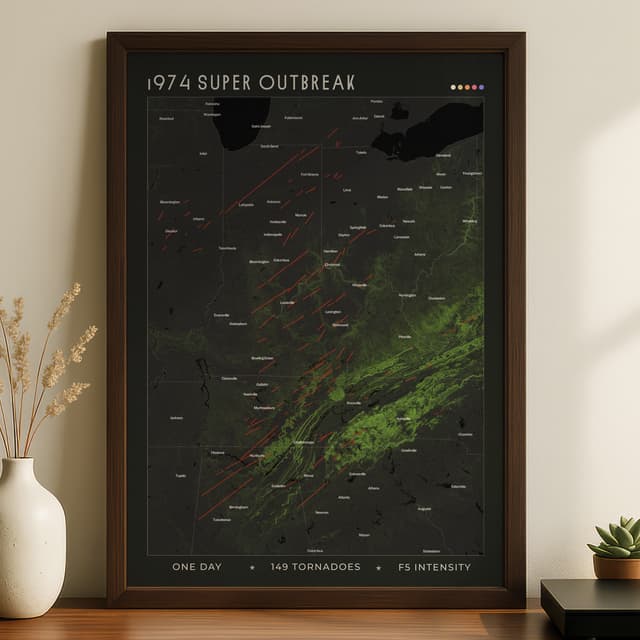
1974 Super Outbreak
On April 3rd and 4th of 1974, the atmosphere across the eastern United States produced 148 confirmed tornadoes in 13 states over the course of roughly 18 hours. 330 people were killed. Over 5,000 were injured. Seven of those tornadoes were rated F5, the highest category on the Fujita Scale. No single event before or since has produced that many violent tornadoes in a single day.
What Happened
The setup was textbook for a large-scale severe weather event but the result exceeded anything forecasters thought possible. A powerful upper-level trough moved across the central plains while an unusually warm and humid air mass surged northward from the Gulf of Mexico. The wind shear profiles were extreme. By early afternoon on April 3rd, supercell thunderstorms were firing in rapid succession ahead of the advancing cold front.
The outbreak began in the early afternoon across the Ohio Valley and the Deep South. Tornadoes were on the ground simultaneously across multiple states. The activity continued through the evening and into the early morning hours of April 4th, stretching from Alabama to Ontario, Canada. By the time the front passed and the atmosphere stabilised, every tornado record that existed had been broken.
The Individual Storms
Several tornadoes from the outbreak remain among the most studied in meteorological history.
The Xenia, Ohio tornado was an F5 that tracked directly through the centre of the city, killing 34 people and destroying or damaging over 1,400 buildings. The tornado was roughly half a mile wide at its peak and left a damage path that cut the city effectively in two. Xenia has been studied extensively as one of the clearest examples of F5-level destruction in a populated area.
The Guin, Alabama tornado killed 28 people when an F5 struck the small Appalachian town. The damage was severe enough that parts of Guin were essentially levelled.
The Brandenburg, Kentucky tornado killed 31 people and destroyed much of the town's downtown area. It was one of the deadliest individual tornadoes of the outbreak.
What made the 1974 event extraordinary was not just the strength of individual tornadoes but the sheer number of violent storms occurring simultaneously. Forecasters and emergency managers were overwhelmed. Communication systems of the era were not designed to handle this many concurrent severe weather events across such a wide area.
Ted Fujita and What the Outbreak Changed
The 1974 Super Outbreak is inseparable from the work of Dr Tetsuya Theodore Fujita. Fujita had already introduced his tornado intensity scale in 1971, but it was this outbreak that gave him the dataset to validate and refine it.
In the days following the outbreak, Fujita chartered a small aircraft and personally surveyed the damage paths from above. He flew over hundreds of miles of destruction, photographing and mapping the damage patterns in meticulous detail. This aerial survey methodology became foundational to how tornado damage is assessed.
What Fujita found confirmed his theories about tornado structure and intensity classification. The variations in damage along a single tornado's path supported his understanding of multiple vortices within a tornado. The range of damage from F0 to F5 across the outbreak gave him a comprehensive dataset that no single event had ever provided before.
The 1974 outbreak is essentially the event that proved the Fujita Scale worked. Without it, the systematic classification of tornado intensity might have developed very differently.
The Human Cost
330 people died in the 1974 Super Outbreak. Thousands lost their homes. Communities across 13 states were damaged or destroyed. The recovery took years in the hardest-hit areas.
The event also exposed serious gaps in how the United States warned its population about severe weather. The sheer volume of warnings needed simultaneously exceeded the capacity of existing systems. The improvements to the tornado warning infrastructure that followed, including expanded radar coverage and revised warning protocols, were direct consequences of what happened on April 3rd and 4th.
Why It Still Matters
The 1974 Super Outbreak remains a reference point in severe weather science. It validated the system that meteorologists still use to classify tornado intensity. It demonstrated the potential scale of tornado outbreaks in ways that had not been documented before. And it provided the data that allowed Ted Fujita to refine the work that bears his name.
The 2011 Super Outbreak surpassed the 1974 event in total tornado count, but the 1974 outbreak retains the record for the most F5 tornadoes in a single event. That distinction matters because it reflects the extraordinary atmospheric conditions of that specific day.
We mapped the 1974 Super Outbreak as a dark, Fujita-style cartographic print. It is in the shop if you want it on your wall.