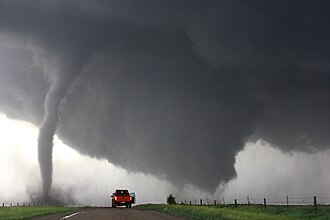
Pilger Twin Tornadoes 2014: Two EF4s Simultaneously in Nebraska
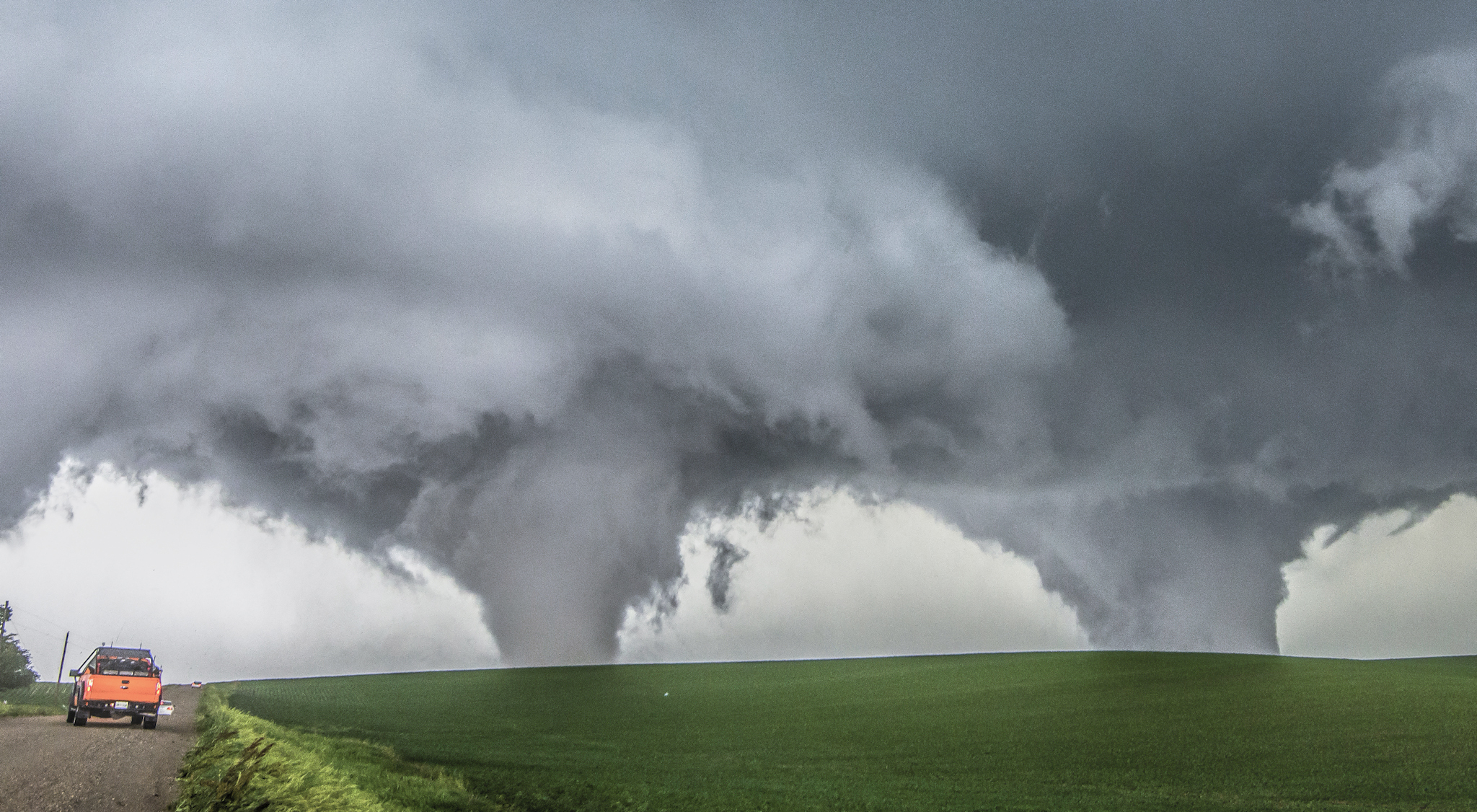
On June 16, 2014, two EF4 tornadoes tracked simultaneously through Pilger, Nebraska, destroying over 75% of the town. Rare multi-vortex event archive with path maps and damage stats.
Overview
On the afternoon of June 16, 2014, a cyclic supercell in northeast Nebraska produced two EF4 tornadoes that were simultaneously on the ground within two miles of each other. The main tornado struck the town of Pilger directly, leveling structures and throwing vehicles. Two people died and 20 were injured. The image of the twin funnels moving northeast across the farmland became one of the most reproduced tornado photographs of the decade. The event also produced a sub-record: the primary tornado was tracked at a forward speed of 94.6 mph during its roping-out phase.
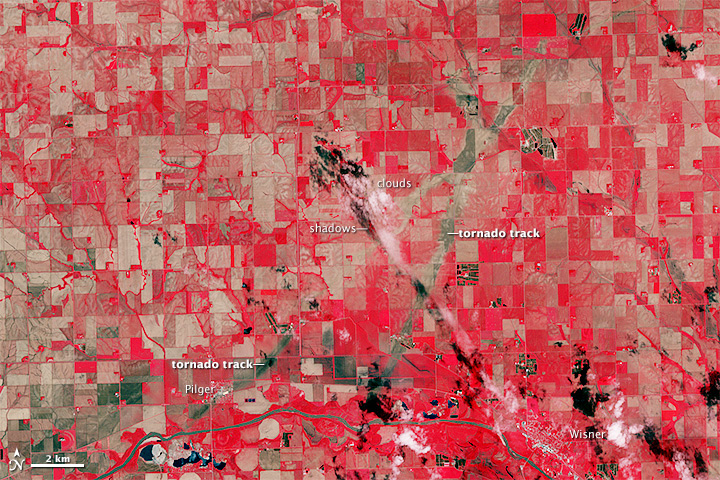
NASA ASTER satellite image showing the two parallel tan scars left by the Pilger tornadoes through red-colored Nebraska vegetation
The Setup
The Pilger setup was a high-shear, moderate-to-high instability environment over the northern Great Plains. Southerly flow at the surface was backing sharply with height, producing a wind shear profile that strongly favored supercell rotation. The parent supercell was cyclic, meaning it produced multiple tornadoes in sequence as the existing mesocyclone filled with rain-cooled air and a new circulation developed adjacent to it. The phenomenon of simultaneous dual-vortex production from a single parent cell was observed in real time by storm chasers and is well documented in subsequent literature.
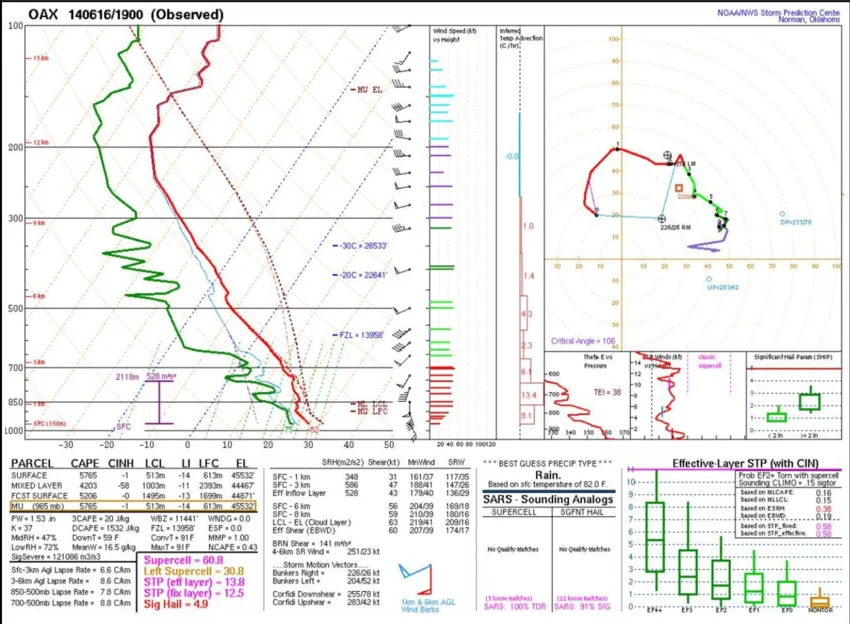
Hodograph diagram showing the extreme curved wind shear profile that enabled the cyclic Pilger supercell
The Tornado
The main tornado struck Pilger at approximately 4:00 p.m. local time. The central path through the town destroyed homes, toppled grain silos, and wrapped vehicles into unrecognizable masses of metal. The second tornado tracked a parallel path two miles to the southeast. At the moment the primary tornado began to rope out, it accelerated dramatically. The measured forward speed of 94.6 mph during this phase was the fastest ever recorded for a significant tornado and had significant implications for chaser safety calculations.
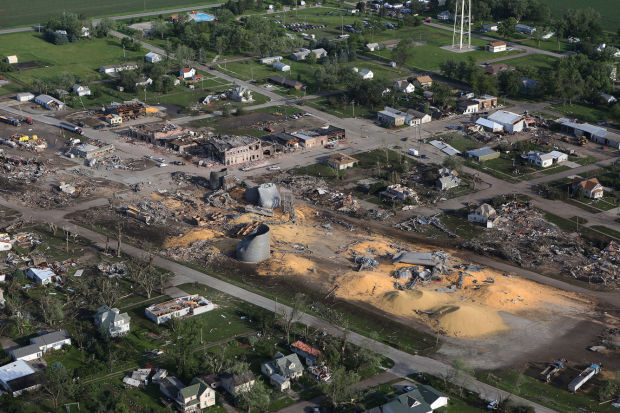
An aerial photograph showing the damage to Pilger
Vortex Interaction
The most scientifically significant aspect of Pilger was the dynamics between the two tornadoes. Researchers studying the event found that the two vortices did not cancel each other out or merge, which is not the predicted behavior of two co-rotating circulations in proximity. Instead, they maintained separation for an extended period, exchanging energy through the shared low-level jet until the secondary vortex expanded to replace the primary as it roped out. The data provided rare direct observation of how vortex competition within a single mesocyclone resolves without mutual annihilation.
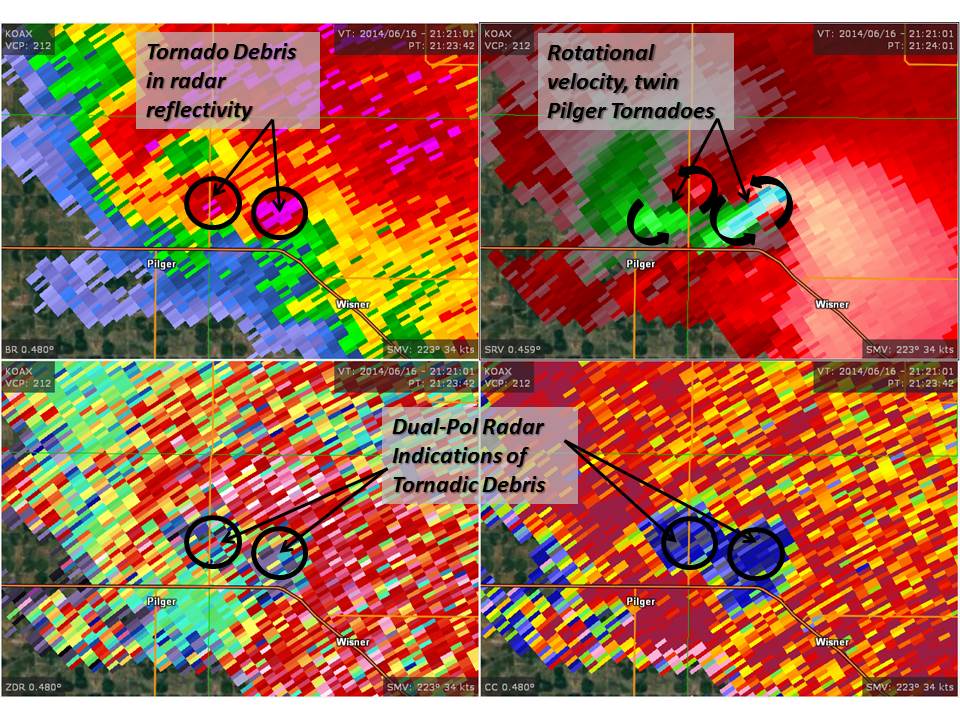
Radar velocity dual-panel showing the simultaneous rotation signatures of both Pilger tornadoes
What Changed
The Pilger tornado became a widely discussed example of how dangerous tornado motion can be, especially during complex storm interactions. Video-based research later suggested an exceptionally high forward speed during its roping-out phase, underscoring how quickly a tornado can outrun assumptions based on typical movement. Rather than triggering a single formal rewrite of storm chaser rules, Pilger reinforced an existing lesson: safe positioning depends on constant escape-route planning, road options, and real-time radar interpretation, not fixed distance alone.