1979 Wichita Falls Tornado: The Terrible Tuesday F4 That Killed 42
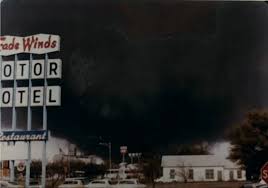
The Wichita Falls "Terrible Tuesday" tornado of April 10, 1979 killed 42 people and injured 1,700 in one of the most destructive single-tornado events in Texas history. Full path and archive.
Overview
April 10, 1979 became known as Terrible Tuesday across north Texas. A multi-vortex F4 struck Wichita Falls at 5:50 p.m., crossing US-287 and cutting through residential neighborhoods at 1.5 miles wide. It killed 45 people and injured 1,740, making it the costliest tornado in American history at the time. The disaster exposed a dangerous and widely held belief about tornado survival that cost lives that day and continued to cost lives for years afterward.
The Setup
The storm developed at the intersection of a surging dryline and a warm front over north-central Texas. An upper-level jet streak at 40,000 feet provided shear in excess of what most operational forecasts considered possible for that time of year. CAPE values were extreme, and the boundary interaction allowed storm initiation to occur rapidly once afternoon heating peaked. The supercell that struck Wichita Falls organized within an hour of initiation and produced the main tornado shortly after.
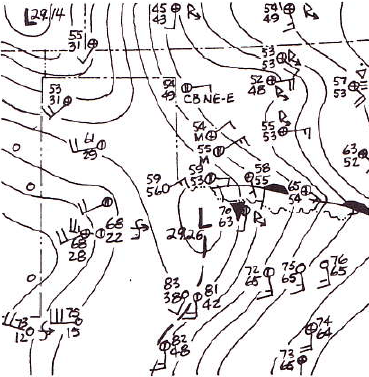
Surface analysis chart showing the dryline and warm front intersection over north-central Texas, April 10, 1979
The Tornado
The tornado began as a multi-vortex funnel observable by residents who had time to watch it approach. As it entered the city, it transformed into what witnesses described as a giant black wall of condensation and debris, a featureless mass that consumed the southern end of Wichita Falls. At its peak, the vortex was a mile and a half wide. The damage across the residential core was characterized by foundation failures, complete roof removals, and cars thrown hundreds of yards. One of the most documented aspects of the storm was what happened on the roads.
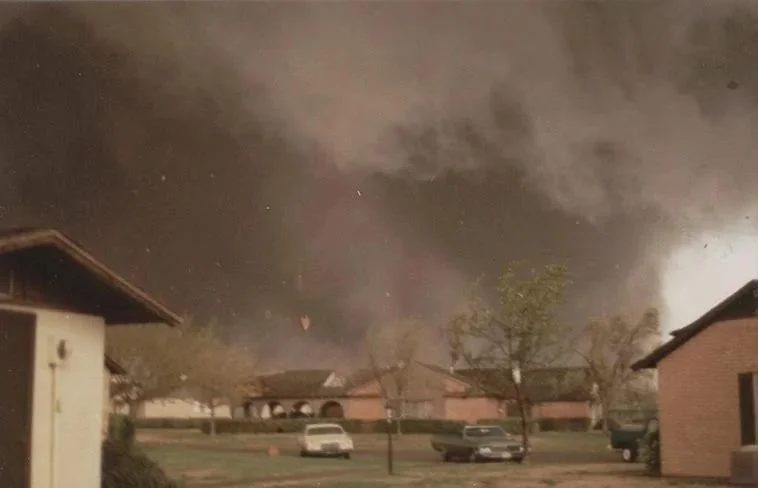
Photograph of the multi-vortex F4 funnel approaching Wichita Falls from the southwest
The Overpass Myth
Twenty-five of the 45 deaths in Wichita Falls were vehicle-related. Many victims tried to escape by car. Others, seeing the approach, pulled under highway overpasses and sheltered in the concrete above their vehicles. The post-event analysis was unequivocal: overpasses do not protect people from tornadoes. The geometry of an overpass creates a natural wind tunnel, accelerating winds through the gap and removing the structural protection that the ground itself would otherwise provide. People who sheltered under bridges on April 10 experienced faster, more focused winds, not slower ones.
What Changed
The Wichita Falls study changed emergency management guidance across the country. The National Weather Service launched a systematic campaign to correct the public assumption that overpasses were safe refuges. In the years following, the guidance shifted clearly: if you are in a vehicle when a tornado approaches, do not seek shelter under an overpass. Abandon the vehicle and lie flat in a ditch or low ground. The correction was driven entirely by the documented fatalities of April 10, 1979. The lesson was reinforced again by El Reno in 2013 and remains a central element of tornado safety education today.