1974 Xenia Ohio Tornado: The Super Outbreak's Most Iconic Strike
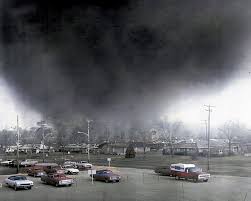
The Xenia, Ohio F5 tornado of April 3, 1974 killed 33 people and destroyed half the city during the historic Super Outbreak. Full event archive, path map, and meteorological context.
Overview
On the afternoon of April 3, 1974, the most active tornado day in recorded history produced 148 vortices across 13 states. Of all of them, the Xenia tornado was the deadliest. It came out of a clear sky to the southwest at 4:33 p.m. and moved through the city in under ten minutes, killing 32 people and injuring over a thousand. The damage it left behind gave Dr. Ted Fujita the evidence he needed to prove one of the most important ideas in tornado physics.
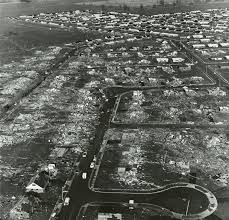
Aerial view of the Arrowhead subdivision after the Xenia tornado, showing clean concrete slabs
The Setup
The Super Outbreak of April 3-4, 1974 was driven by a powerful surface low in the Plains that funneled Gulf moisture northward into a sharp temperature gradient across the Ohio Valley. The synoptic environment was extreme by any measure: high CAPE, deep-layer shear, and a strong jet streak at 300 millibars converging over the same region. The Xenia supercell developed in this environment and maintained continuous rotation from southwest of Bellbrook all the way into Clark County. At Wright-Patterson Air Force Base, the WSR-57 radar captured a massive, textbook hook echo over the city during peak intensity.
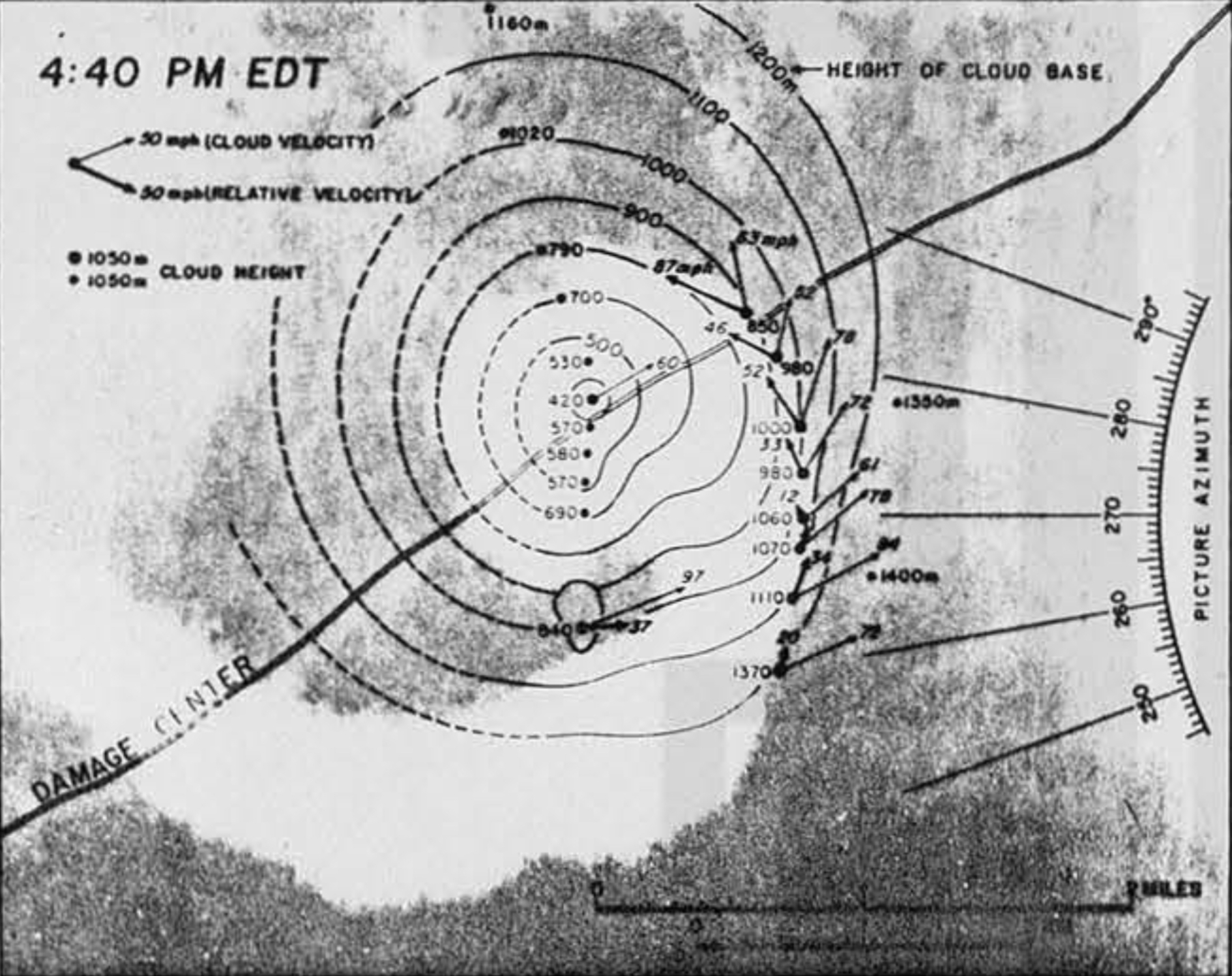
WSR-57 radar hook echo from Wright-Patterson Air Force Base showing the Xenia supercell
The Tornado
What made the Xenia tornado scientifically significant was captured on film by multiple cameras. The footage showed up to five distinct sub-vortices rotating around a common center, each one a smaller, high-velocity funnel whipping through neighborhoods. The Arrowhead subdivision received the full impact of this multi-vortex structure. Entire rows of brick homes were swept clean from their concrete slabs, leaving no debris behind. The slabs themselves were scoured. Nothing remained to indicate that hundreds of homes had stood there hours before.
Ted Fujita
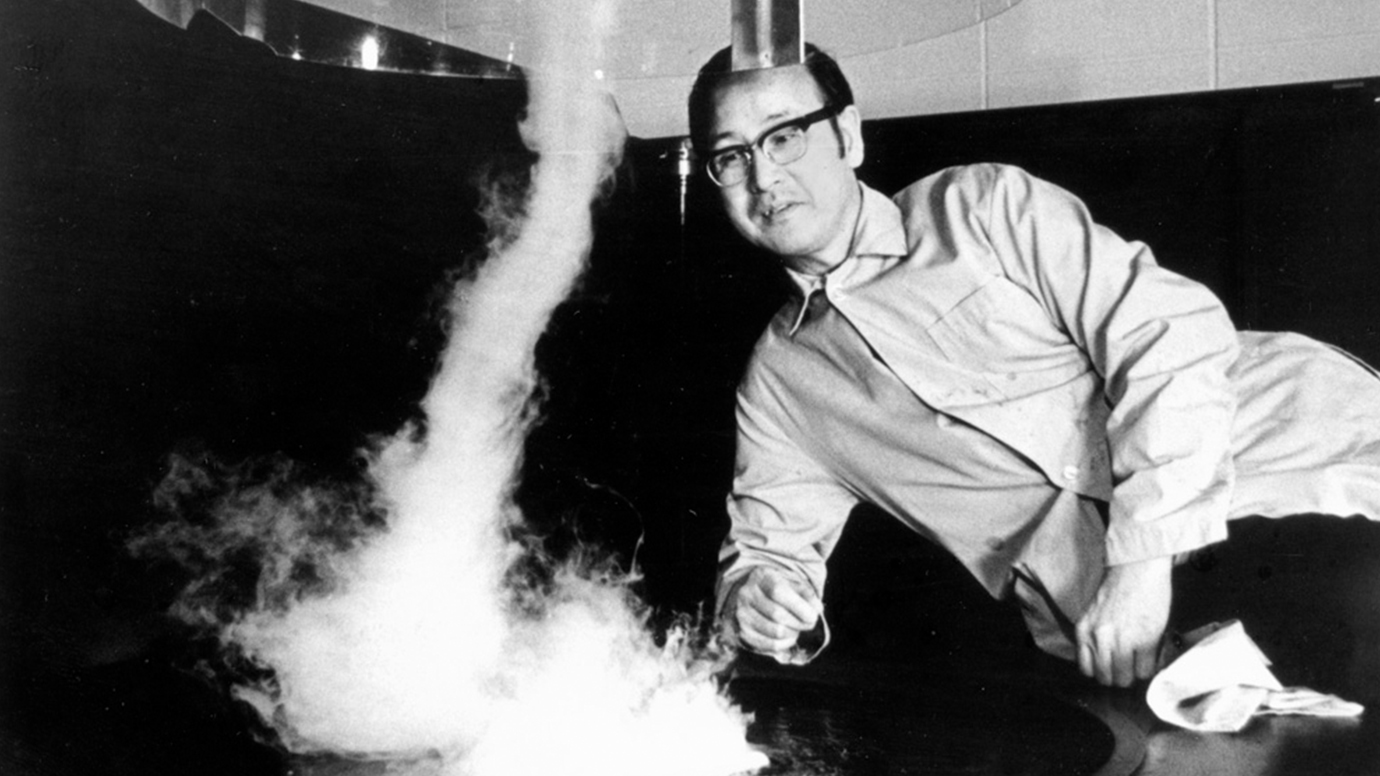
Fujita had theorized for years that the most intense damage within a tornado was not evenly distributed but rather caused by smaller, embedded sub-vortices moving at velocities far exceeding the main circulation. The film footage from Xenia was the proof. Using frame-by-frame analysis, he demonstrated exactly how the five sub-vortices interacted, merged, and intensified over the Arrowhead area. This was the empirical foundation for multi-vortex theory. It transformed how engineers modeled the interior of a tornado and led to a more realistic understanding of why damage patterns are often inconsistent within a single damage swath.
What Changed
Xenia helped demonstrate that tornado damage cannot be understood only in terms of a single, uniform wind field. The storm’s multiple-vortex structure produced narrow swaths of especially intense damage, reinforcing the importance of a tornado’s internal circulation in both meteorological analysis and post-storm damage assessment. Rather than directly transforming building codes, Xenia became part of the broader research record showing that localized suction vortices can cause destruction well beyond what a simple average wind estimate would suggest