What Is a Shelf Cloud?
A shelf cloud marks the leading edge of a storm's cold outflow and can look dramatic from the ground. How it forms, what it indicates, and how to tell it apart from a wall cloud.
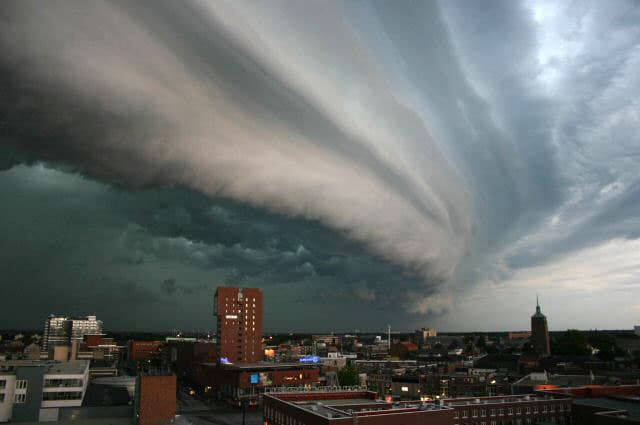
A shelf cloud forms along the leading edge of a thunderstorm's outflow boundary, where cold air draining from the storm's downdraft undercuts the warm, moist inflow air ahead of it. The result is a low, wedge-shaped cloud structure that extends horizontally along the storm's forward flank, often spanning miles of sky, with a turbulent, rolling base and clearer air beneath it.
Formation Mechanism
When a thunderstorm produces rain and hail, the falling precipitation drags cold air downward with it, creating a pool of cold, dense air that spreads outward ahead of the storm at ground level. This cold pool, also called the outflow boundary, acts as a wedge. Where it meets the warmer air ahead of the storm, the warm air is forced upward along the boundary of the cold pool.
As this warm moist air rises along the leading edge of the cold pool, it cools and condenses, forming cloud at the boundary level. The resulting cloud structure takes on a horizontal, shelf-like appearance because the lifting is occurring along the entire length of the outflow boundary simultaneously, rather than in a single column.
The underside of a shelf cloud is often turbulent and agitated, reflecting the chaotic mixing zone between the cold outflow and warm inflow. Wind direction shifts sharply at the outflow boundary, and that wind shift is usually felt on the ground before the shelf cloud overhead becomes dramatic.
What It Indicates About Storm Organisation
A well-defined shelf cloud indicates that the storm above has a strong, expansive cold pool and a substantial inflow region. This is generally a sign of an organised, linear convective system such as a squall line or bow echo rather than a discrete supercell. Some isolated convective storms produce shelf clouds, but the most photogenic examples are typically associated with the leading edge of mesoscale convective systems moving through at speed.
For storm chasers, a shelf cloud is often a sign that the storm is outflow-dominant. The cold pool is winning. The storm's downdraft is spreading faster than the updraft is pulling in new warm air. While this can produce damaging winds, it is typically not the kind of storm structure associated with significant tornadoes. In supercell environments, an overdeveloping cold pool can kill rotation and prevent tornado development entirely. Understanding this is useful for positioning decisions in the field.
Shelf Cloud vs Wall Cloud
These two features are frequently confused, and the confusion matters because they indicate opposite things about storm structure.
A shelf cloud is an inflow feature. It forms at the leading edge of the storm ahead of the cold pool, where warm air is being lifted into the storm. A wall cloud is also an inflow feature, but it forms directly beneath the updraft at the storm's rear flank, where the strongest sustained inflow is occurring and where rotation is developing. The shelf cloud is wide and elongated, spanning the entire forward flank of the storm. The wall cloud is compact and localised, sitting below the updraft base, typically on the storm's southwest flank.
A shelf cloud is striking and widely photographed because it is visible from a great distance as a storm approaches. A wall cloud is more significant operationally because it marks the location of the mesocyclone and indicates potential tornado development. Knowing the difference is one of the more basic pieces of visual storm literacy for someone getting into chasing or severe weather observation.
Arcus and Roll Clouds
The shelf cloud is one type of arcus cloud, the general classification for cloud structures formed along convective outflow boundaries. The other is the roll cloud: a completely detached, roughly horizontal tube of cloud that forms along an outflow boundary and rotates slowly on its horizontal axis. Roll clouds do not retain any attachment to the parent storm and can persist for considerable distances from the convective system that generated them.
Both arcus types and the variety of tornado-associated cloud features speak to how visible the atmosphere's internal dynamics can be once you know what the shapes are telling you.
The shelf cloud is not a warning sign in the way a wall cloud is, but it is a clear signal that the atmosphere is doing something substantial in the miles behind it.
Archives for storm chasers and meteorology obsessives
Museum-quality prints and technical apparel built on real data. Designed by those who chase.