What Are Red Sprites?
Enormous electrical discharges above thunderstorms that flash red for milliseconds. How transient luminous events were discovered, what causes them, and why they are almost impossible to see with the naked eye.
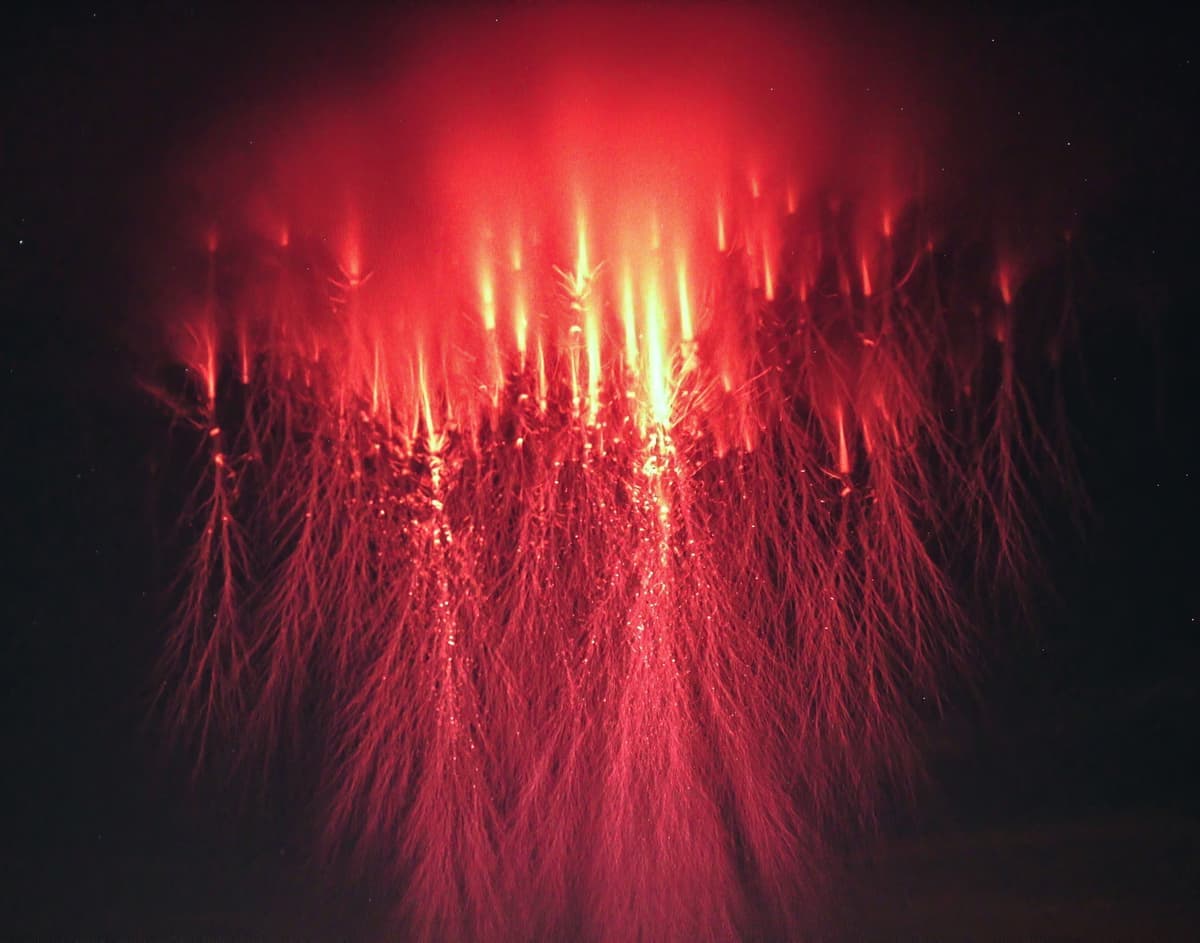
Red sprites are large-scale electrical discharges that occur above active thunderstorms, typically at altitudes between 50 and 90 kilometres above the surface. They flash for just a few milliseconds, appearing as reddish or orange luminous structures that extend upward from the cloud tops into the mesosphere. They are part of a family of phenomena called transient luminous events, or TLEs, and they are among the most recently discovered large-scale atmospheric phenomena on Earth. They are often triggered by massive supercell systems, including those that cause massive severe weather events like the 2011 Super Outbreak.
How They Were Discovered
Pilots and high-altitude observers had reported brief flashes of light above thunderstorms for decades, but the scientific community did not confirm their existence until 1989. A team from the University of Minnesota accidentally captured the first photographic evidence of sprites on a low-light video camera during a test of a new imaging system. The camera was pointed at the horizon above a distant thunderstorm, and the resulting footage showed clear luminous structures above the cloud tops.
The accidental nature of the discovery reflects the difficulty of observing sprites. They last for roughly 5 to 20 milliseconds. They occur above thunderstorms, meaning they are only visible from a significant distance where the observer has a clear view above the cloud deck. They are too brief and too faint to see reliably with the naked eye under most conditions, though trained observers looking at active storms from a distance of several hundred kilometres have reported seeing them.
What Causes Them
Sprites are triggered by strong positive cloud-to-ground lightning strokes within the thunderstorm below. Positive CG lightning transfers positive charge from the upper regions of the cloud to the ground. This type of lightning is less common than negative CG lightning but carries significantly more charge and current.
When a strong positive stroke occurs, it temporarily alters the electric field in the mesosphere above the storm. The resulting field is strong enough to cause electrical breakdown of the thin air at those altitudes, producing the luminous discharge that we see as a sprite.
The shapes of sprites vary. The most common form is the columnar sprite, which appears as one or more vertical columns of light extending upward from the cloud top. Carrot sprites have a broader, diffuse upper region with tendrils extending downward. Jellyfish sprites combine a bright upper section with long trailing streamers. These morphological differences reflect variations in the atmospheric conditions and the properties of the triggering lightning stroke.
Where to See Them
Sprites occur globally, wherever there are large, electrically active thunderstorms. They have been documented over the Great Plains of the United States, the tropical Atlantic and Pacific, the Mediterranean, and the Indian subcontinent.
The Great Plains are the most productive region for sprite observation because the large, long-lived mesoscale convective systems that develop there produce the strong positive lightning strokes that trigger sprites. Observers in western Kansas, Colorado, and Nebraska can sometimes observe sprites above distant storm complexes to the east during summer months.
Dedicated sprite observation requires clear skies, a distant thunderstorm below the horizon, and ideally a low-light video camera. The human eye can detect sprites under favourable conditions, but video confirmation is the standard for research purposes.
Part of a Larger Picture
Sprites are not the only transient luminous event. The TLE family includes blue jets, which shoot upward from cloud tops into the stratosphere; elves, which are rapidly expanding disc-shaped glows at the base of the ionosphere; and gigantic jets, which connect thunderstorm tops directly to the ionosphere. Each type has a different formation mechanism, altitude range, and appearance.
The study of TLEs is relatively young. The fundamental physics linking thunderstorm electrical activity to mesospheric discharges is still being refined. Sprite research has implications for understanding the global electrical circuit, the chemistry of the upper atmosphere, and the coupling between the troposphere and the mesosphere.
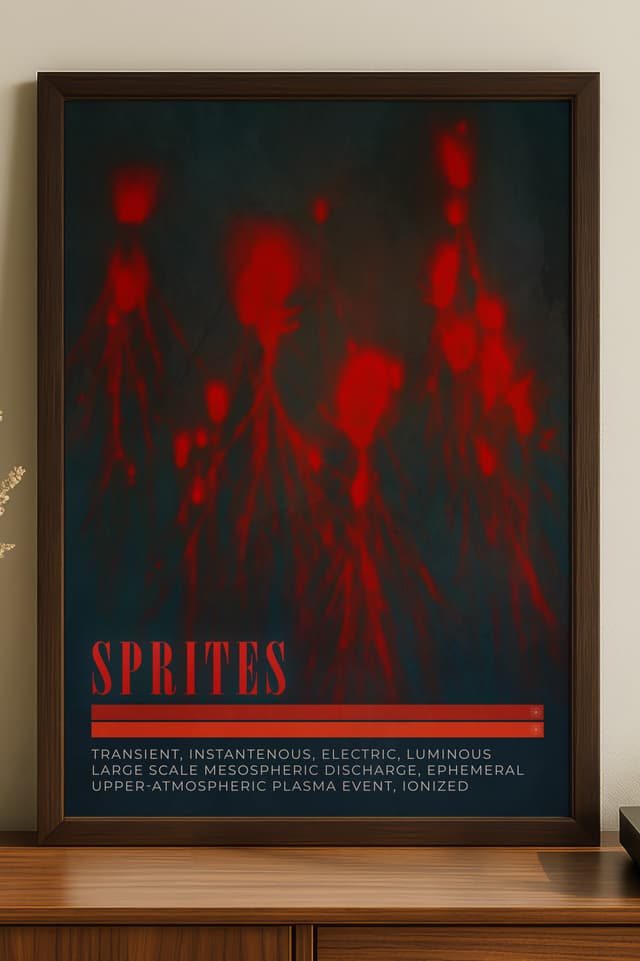
We made a retro-style red sprites print. It is in the shop.
Archives for storm chasers and meteorology obsessives
Museum-quality prints and technical apparel built on real data. Designed by those who chase.