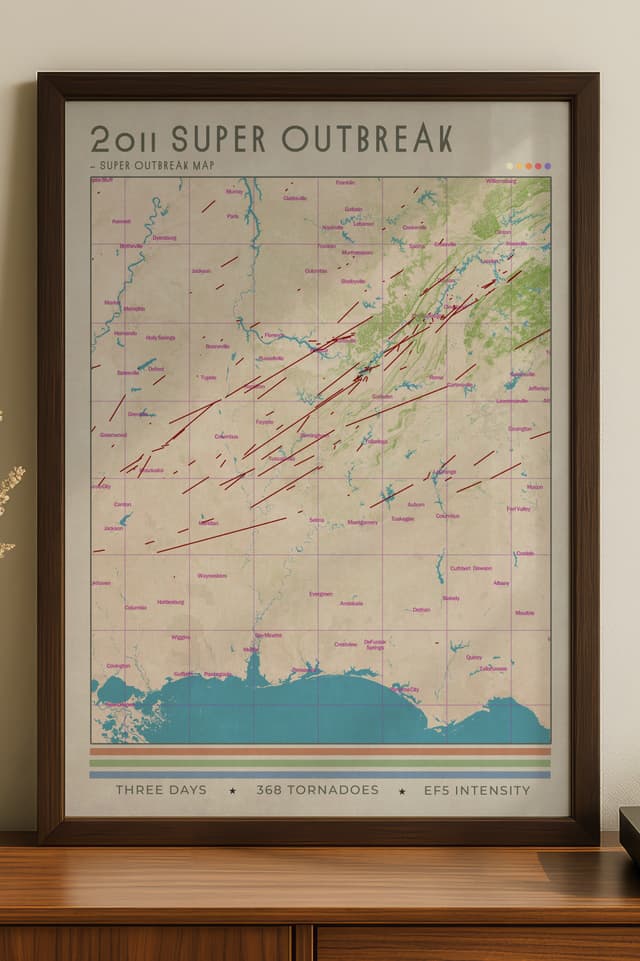
2011 Super Outbreak
On April 27th, 2011, the atmosphere across the southeastern United States produced 368 confirmed tornadoes in 21 states over the course of 24 hours. Four of those tornadoes were rated EF5. 324 people were killed. The 2011 Super Outbreak surpassed the 1974 Super Outbreak in total tornado count and stands as the largest single-day tornado event in recorded history.
The Meteorological Setup
An unusually powerful upper-level trough was digging across the Mississippi Valley on April 27th. Ahead of it, a deep surface low was pulling Gulf moisture northward into an environment already loaded with instability. Dewpoints in the low to mid 70s°F were present across Alabama and Mississippi by morning. The wind shear profiles were among the strongest ever observed during a tornado outbreak, with 0-6 km bulk shear values exceeding 70 knots across much of the affected area.
The Storm Prediction Center had issued a high risk the day before and upgraded the threat language to emphasise the potential for a historic outbreak. Forecasters drew explicit comparisons to 1974. The messaging was clear: this had the potential to be catastrophic. The atmosphere delivered on every part of that forecast.
The Outbreak
The first round of severe weather moved through the Tennessee Valley during the early morning hours, producing significant tornadoes in the pre-dawn darkness. This initial wave weakened but left behind an outflow boundary that would become critically important later in the day.
By early afternoon, discrete supercells began firing along and south of the morning outflow boundary across Mississippi and Alabama. These storms rapidly intensified and began producing violent tornadoes. The interaction between the residual boundary and the new convection created an environment where supercells were cycling continuously, producing long-track, violent tornadoes one after another.
Between roughly 3:00 PM and 10:00 PM local time, the outbreak reached its peak. Multiple EF4 and EF5 tornadoes were on the ground simultaneously across Alabama, Mississippi, Tennessee, and Georgia. Emergency management systems were overwhelmed. Warnings were being issued continuously across dozens of counties.
The Individual Storms
The Tuscaloosa-Birmingham EF4 tracked 80.7 miles across central Alabama, passing directly through Tuscaloosa and then into parts of the Birmingham metropolitan area. The tornado was up to 1.5 miles wide. 64 people were killed. The damage path cut through densely populated areas, with entire neighbourhoods destroyed. This was one of the most well-documented tornadoes in history, captured on video from dozens of angles as it moved through the city.
The Smithville, Mississippi EF5 struck the small town of Smithville with catastrophic force. The destruction was absolute across parts of the town. Vehicles were thrown hundreds of yards. The tornado demonstrated the full extent of EF5 damage indicators.
The Hackleburg-Phil Campbell-Tanner-Harvest EF5 tracked 132 miles across northwest Alabama. 71 people were killed along its path, making it the deadliest single tornado of the outbreak and the deadliest in Alabama history. The damage in Hackleburg was severe enough that parts of the town were unrecognisable after the storm passed.
The Rainsville EF5 struck the DeKalb County area of northeast Alabama. Combined with the other violent tornadoes occurring simultaneously, it contributed to a situation where rescue resources were stretched across the entire state.
What Made 2011 Different
The 1974 Super Outbreak validated the Fujita Scale. The 2011 event tested the resilience of every warning and communication system built in the decades since.
In 1974, the warning infrastructure was primitive by modern standards. By 2011, the National Weather Service had Doppler radar coverage, sophisticated numerical weather prediction models, and a well-established system of watches, warnings, and emergency alerts. The SPC forecast was accurate. The warnings were timely. The meteorological community performed well.
324 people still died. The scale of the outbreak overwhelmed the capacity of even well-prepared communities. When multiple violent tornadoes are striking populated areas simultaneously, the practical limits of shelter, communication, and response become real regardless of how good the forecasting is.
The 2011 event accelerated improvements in wireless emergency alert systems and prompted significant investment in community storm shelter programmes, particularly in Alabama where the majority of deaths occurred. This echoed the changes following the 1999 Oklahoma tornado outbreak and emphasized the need for proper warning dissemination, a chronic problem since the 1965 Palm Sunday tornado outbreak.
Why It Still Matters
The 2011 Super Outbreak remains the benchmark for what the atmosphere is capable of producing. It demonstrated that a single day can generate over 350 tornadoes, including four of the highest possible rating. The meteorological data collected during the outbreak continues to inform research into tornado climatology, storm-scale dynamics, and the limits of predictability.
The event also sits alongside 1974 as a permanent reference point in the ongoing conversation about tornado intensity and classification. The 1974 outbreak produced more F5/EF5 tornadoes. The 2011 event produced more total tornadoes. Both days represent the extreme upper end of what severe convective weather can produce, and both fundamentally shaped how the field approaches outbreak-scale events.
We mapped the 2011 Super Outbreak as a vintage Fujita-style cartographic print. It is in the shop.