What is a Dust Devil?
Small, rotating columns of air that form on hot days without any thunderstorm in sight. How surface heating creates vortices, and why they are technically not tornadoes.
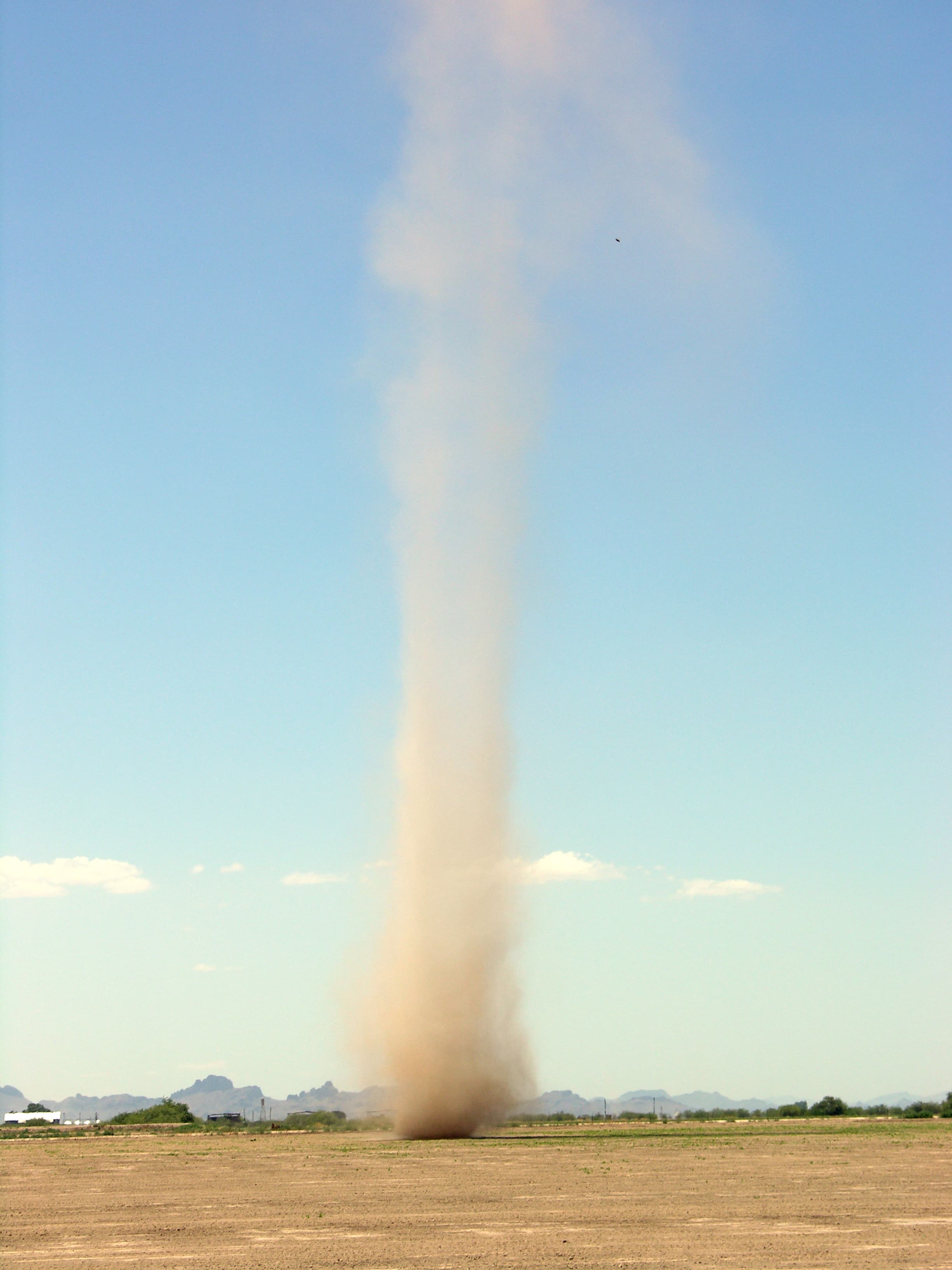
A dust devil is a small, rapidly rotating column of air that forms at the surface on hot, dry days when the ground heats the air directly above it. The heated air rises quickly, and if ambient wind shear or surface irregularities introduce rotation, the rising column can tighten into a visible vortex that picks up dust, sand, and debris from the ground. Dust devils are not tornadoes. They form through a completely different mechanism and are not connected to thunderstorms or any form of deep convection.
How They Form
The formation mechanism starts with surface heating. On a sunny day, bare or dark ground absorbs solar radiation and heats the air immediately above it. This superheated boundary layer becomes buoyant and begins to rise. If the surface heating is strong enough and the surrounding air is relatively calm, the rising thermal can organise into a coherent column.
Rotation enters the system through horizontal wind shear near the surface or through the interaction of the thermal with local terrain features. Even small variations in wind speed and direction, or the flow around a building, fence line, or ridge, can introduce vorticity that the rising thermal column stretches and concentrates vertically. The result is a spinning column of air that extends from the ground upward into the developing thermal.
The dust devil becomes visible when it lofts loose material from the surface. In desert environments, this means dust and sand. On agricultural land, it might be soil, crop debris, or chaff. The visible column can range from a few metres to hundreds of metres in height, depending on the strength of the thermal and the available surface material.
How They Differ From Tornadoes
The distinction is fundamental and relates to direction of formation.
A tornado forms from the top down. A mesocyclone within a supercell thunderstorm extends its rotation downward toward the surface. The vortex is connected to a deep convective cloud system and is driven by the dynamics of the parent thunderstorm. The full sequence of how tornadoes form involves multiple atmospheric layers interacting across thousands of feet of depth.
A dust devil forms from the bottom up. Surface heating creates a rising thermal that acquires rotation through local wind shear. There is no parent thunderstorm, no mesocyclone, and no deep convective forcing. Dust devils are boundary layer phenomena driven by solar heating of the ground. Because they form differently, they are not considered tornado types.
This difference also explains the intensity gap. The most powerful tornadoes produce winds exceeding 300 mph, causing F4 or F5 damage like the Elie, Manitoba tornado. Dust devils rarely exceed 60 mph and most are considerably weaker. The energy source for a tornado is the latent heat release throughout a deep convective column tens of thousands of feet tall. The energy source for a dust devil is the solar heating of a patch of ground.
Where They Form
Dust devils are most common in arid and semi-arid environments where strong surface heating and loose surface material are both abundant. The deserts of the American Southwest, the Australian Outback, the Sahara, and the Middle East all produce dust devils regularly.
They also form in temperate agricultural areas during summer, particularly over freshly ploughed or harvested fields where dark soil is exposed to direct sunlight. Industrial sites, car parks, and other large areas of exposed dark surface can generate dust devils in the right conditions.
The strongest dust devils on record have damaged structures and overturned vehicles, but these are outliers. The vast majority are weak, brief, and harmless. Their typical lifespan is a few minutes, after which the thermal column weakens and the vortex dissipates.
Dust Devils on Mars
The Martian atmosphere produces dust devils that dwarf their terrestrial counterparts. Mars rovers and orbiters have documented Martian dust devils exceeding 10 kilometres in height. The thin Martian atmosphere and intense surface heating during the Martian day create conditions that are extremely favourable for thermal vortex formation.
Martian dust devils are scientifically significant because they play a role in redistributing dust across the planet's surface. They have also been observed cleaning dust from the solar panels of rovers, extending their operational lifetimes beyond initial mission projections.
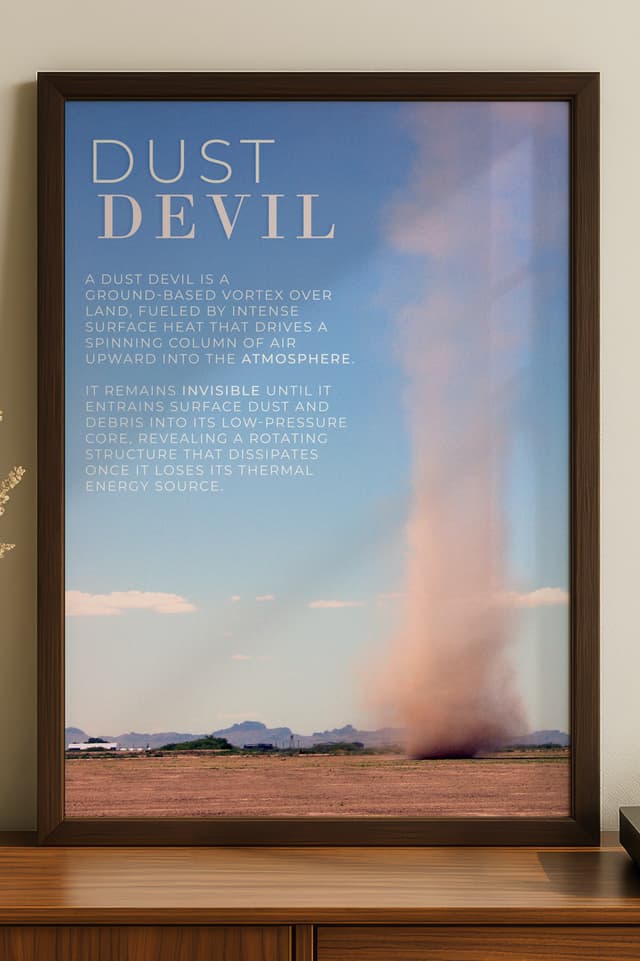
We have a vintage-style dust devil print. It is in the shop.
Archives for storm chasers and meteorology obsessives
Museum-quality prints and technical apparel built on real data. Designed by those who chase.