How Do Tornadoes Form?
Most tornadoes form from supercell thunderstorms through a process involving wind shear, a rotating updraft, and a downdraft that concentrates rotation near the ground. Here is how it actually works.
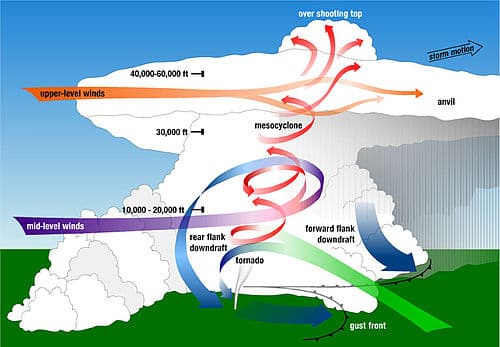
Most tornadoes form from supercell thunderstorms, and the process involves several distinct atmospheric mechanisms working together in a specific sequence. The full chain from ordinary thunderstorm to tornado requires the right combination of moisture, instability, and wind shear, followed by a secondary process near the ground that concentrates rotation into a tight enough column to produce a surface vortex.
The Foundation: Wind Shear
Wind shear is the change in wind speed or direction with altitude. In tornado-producing environments, winds near the ground typically blow from the south while winds at higher altitudes blow from the west or southwest at significantly greater speeds. This creates horizontal vorticity: an invisible rotating tube of air oriented along a roughly east-west axis at low altitudes.
On its own, horizontal vorticity produces no tornado. What it provides is the raw material for rotation within a developing thunderstorm.
Building the Supercell
When a thunderstorm's updraft develops in a strongly sheared environment, it interacts with the horizontal vorticity immediately. The updraft tilts the horizontal vortex tubes into the vertical, converting horizontal rotation into vertical rotation within the storm. As more warm moist air is drawn upward, this vertical rotation deepens and intensifies into a mesocyclone: the deep rotating updraft that defines a supercell thunderstorm.
Wind shear also performs a second function: it separates the storm's updraft and downdraft spatially. In an ordinary thunderstorm, precipitation falls back through the updraft column, generating a downdraft that chokes off the inflow and kills the storm within 30 to 60 minutes. In a supercell, the shear tilts the storm so that the updraft and downdraft occupy different regions of the storm. The storm can sustain itself for hours.
The Mesocyclone Deepens
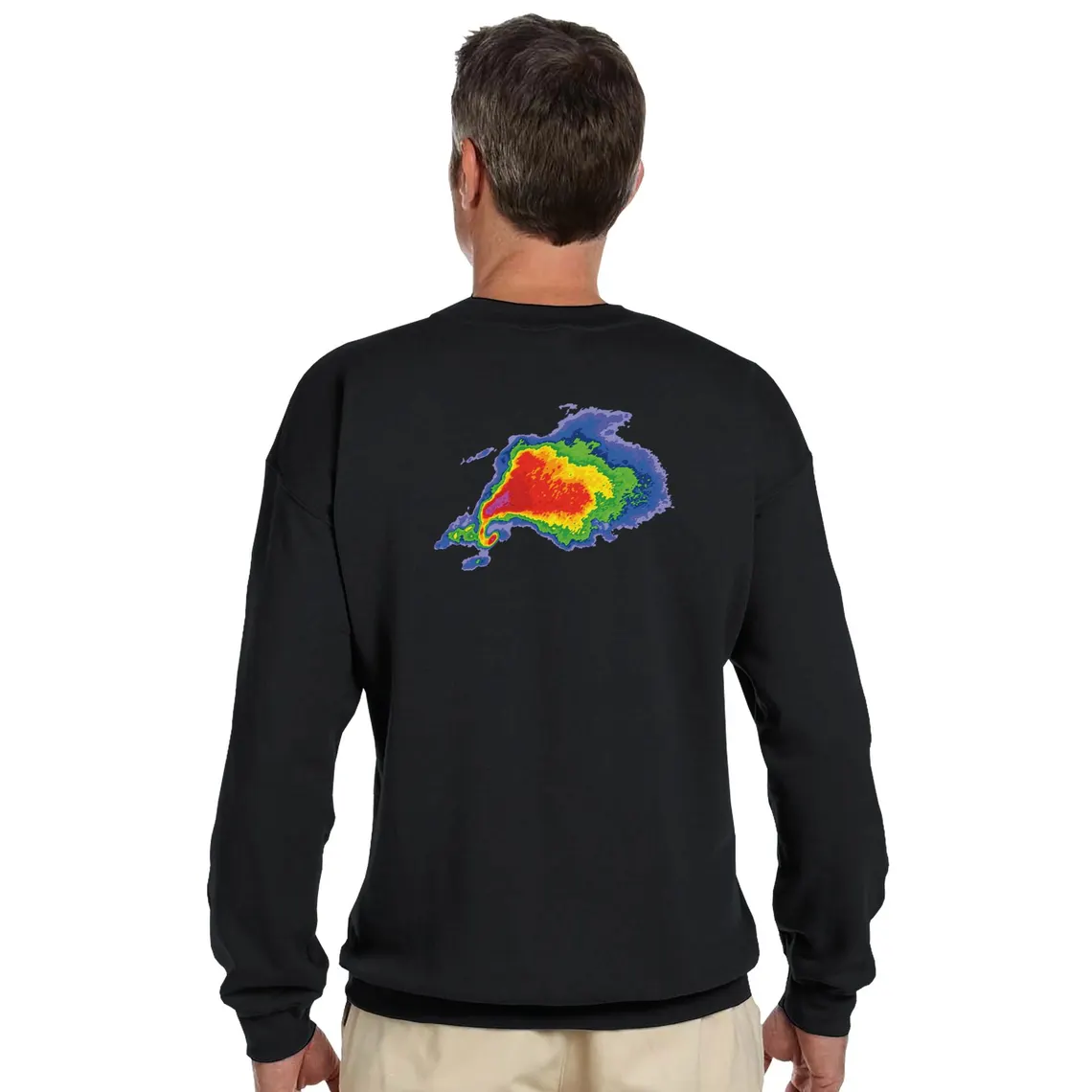
A mature supercell mesocyclone extends from near the surface up through the mid-levels of the storm, spanning thousands of feet of depth. As it rotates, it organises the storm's internal structure. Precipitation is drawn around the back side of the mesocyclone by the rotating wind field, producing the hook echo visible on radar: precipitation wrapping around the storm's southwest flank.
The rear flank downdraft develops at the back of the mesocyclone, where dry air from mid-levels is drawn downward around the rotating updraft. As the mesocyclone matures, the RFD wraps progressively further around the circulation, descending to near the ground and interacting with the surface inflow.
The Wall Cloud and Tornado Development
At cloud base level, the strongest inflow region directly beneath the mesocyclone produces a lowering of the cloud base. This is the wall cloud: a compact, rotating lowering that marks the base of the mesocyclone. When the wall cloud develops and rotates persistently, the conditions for tornado formation are in place below.
Tornado development requires the low-level rotation to tighten to tornado scale. The leading mechanism involves the RFD surging forward around the mesocyclone and interacting with horizontal vorticity in the boundary layer near the surface. This horizontal vorticity gets tilted and stretched rapidly into the vertical, concentrating rotation in an increasingly small area. When this concentration reaches a critical threshold, a visible funnel extends from the wall cloud and a surface circulation begins.
Exactly what determines whether this process completes is not fully understood. The boundary layer thermodynamics in the final moments before tornado touchdown are the subject of ongoing research. What is clear is that not every mesocyclone produces a tornado. Roughly 25 to 30 percent of supercells do.
Non-Supercell Tornadoes
A significant minority of tornadoes do not form from supercell mesocyclones. Understanding the distinction matters because the warning indicators differ.
Landspouts form upward from the ground rather than downward from a rotating storm. A shallow surface vortex develops along a convergence boundary, typically the edge of an outflow or a surface boundary, and is then stretched vertically by a developing but non-rotating updraft overhead. Landspouts are generally weaker than supercell tornadoes but are real tornadoes capable of causing damage and injury.
Waterspouts form over water through a similar process to landspouts in fair-weather conditions. Tornadic waterspouts that form from supercells moving over water are equivalent in intensity to land tornadoes and are reclassified as tornadoes if they move onshore.
Quasi-linear convective system tornadoes can form along squall lines. These are typically brief and relatively weak compared to supercell tornadoes, but they can form with minimal warning because the parent storm structure is different from the organised supercell, and chasers and forecasters use different indicators to identify them.
A Complete Picture
The full variety of tornado types reflects the range of formation mechanisms that can produce surface rotation. Supercell tornadoes are the most studied and the most frequently violent. Understanding how they form, from the initial wind shear through the mesocyclone to the RFD and the final concentration of low-level rotation, is the foundation for understanding tornado forecasting, radar interpretation, and safe positioning in the field.
If you plan to be around severe weather in any capacity, the meteorology is where to start, and the storm chasing beginners guide covers the practical application of that knowledge.
What forecasters and chasers are doing when they watch a developing supercell is tracking each stage of this process in real time, looking for the moment when the sequence completes.
Archives for storm chasers and meteorology obsessives
Museum-quality prints and technical apparel built on real data. Designed by those who chase.