What Is a Mesocyclone?
A mesocyclone is the deep rotating updraft that defines a supercell thunderstorm. How it forms through wind shear, what it looks like on radar, and why most mesocyclones never produce a tornado.
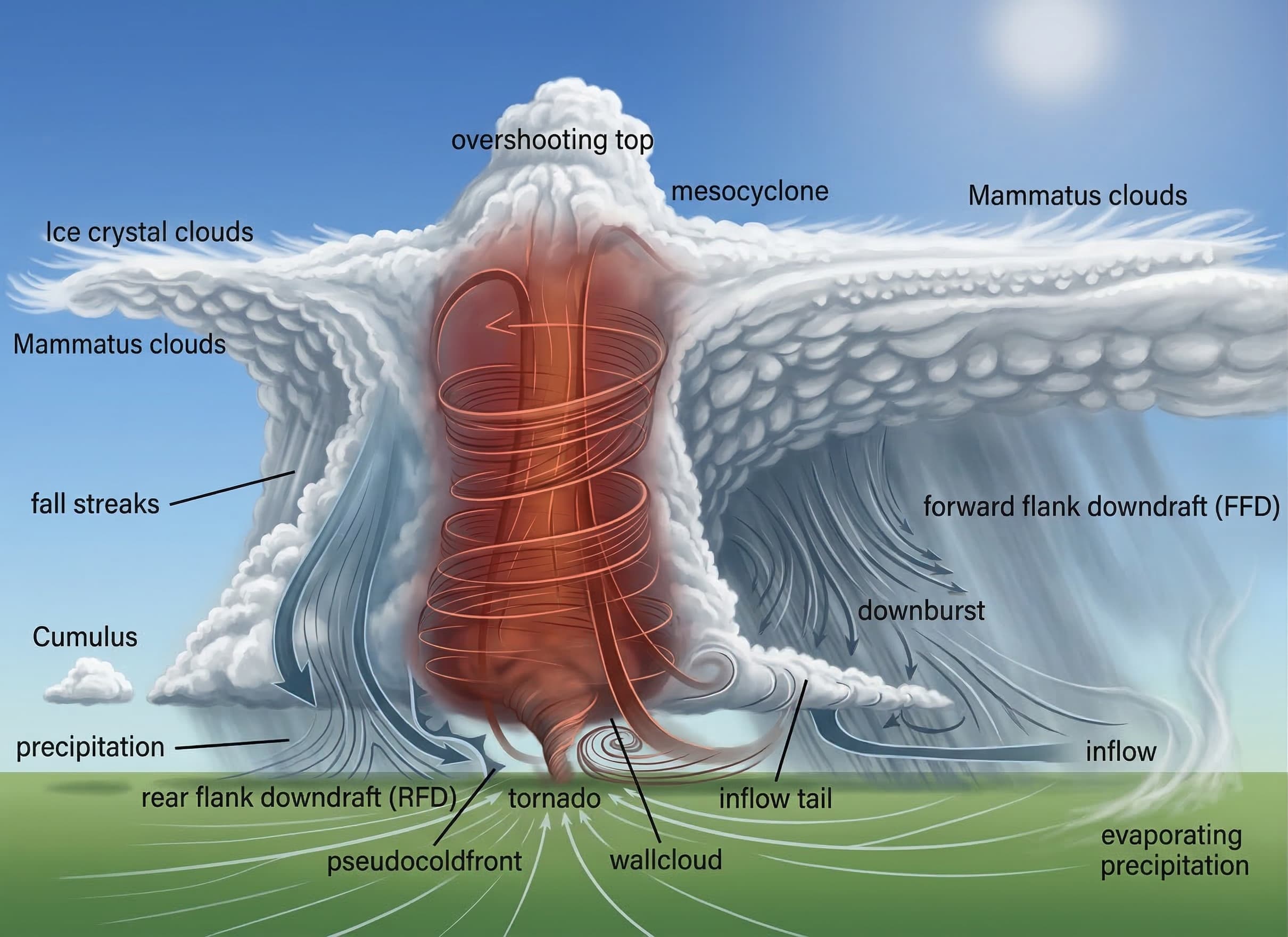
A mesocyclone is a deep, persistent column of rotating air within a thunderstorm's updraft. Its presence is what separates a supercell from every other type of thunderstorm. Mesocyclones are the parent circulation from which tornadoes can develop, though most mesocyclones do not produce one.
How It Forms
Mesocyclone formation begins in the lowest few kilometres of the atmosphere, where wind shear is strongest. When surface winds blow from the south and winds at mid-levels blow from the west at significantly higher speeds, the difference in speed and direction creates horizontal vorticity: an invisible tube of rotating air oriented along a roughly east-west axis.
When a thunderstorm's updraft develops in this environment, it tilts these horizontal vortex tubes into the vertical. The updraft essentially takes rotating air that was horizontal and stands it on end. Once vertical rotation is established within the updraft, it deepens and intensifies as more air is drawn upward into the storm. This is the mesocyclone. It can extend from near the surface to the upper portions of the storm, spanning depths of 5 to 10 kilometres in a well-organised supercell.
The mesocyclone both sustains and is sustained by the supercell's structure. Its rotation separates the updraft and downdraft spatially, preventing the storm from being choked by its own precipitation. This is why supercells can persist for hours while ordinary thunderstorms dissipate in under an hour.
How It Appears on Radar
On Doppler radar, a mesocyclone appears as a velocity couplet: a zone of strong inbound winds adjacent to a zone of strong outbound winds in close proximity. Because Doppler radar measures the radial velocity of precipitation particles moving toward or away from the radar beam, rotation within the storm shows up as opposing velocities side by side. A tight, intense couplet with a velocity difference of 50 knots or more across a small distance indicates strong, organised rotation.
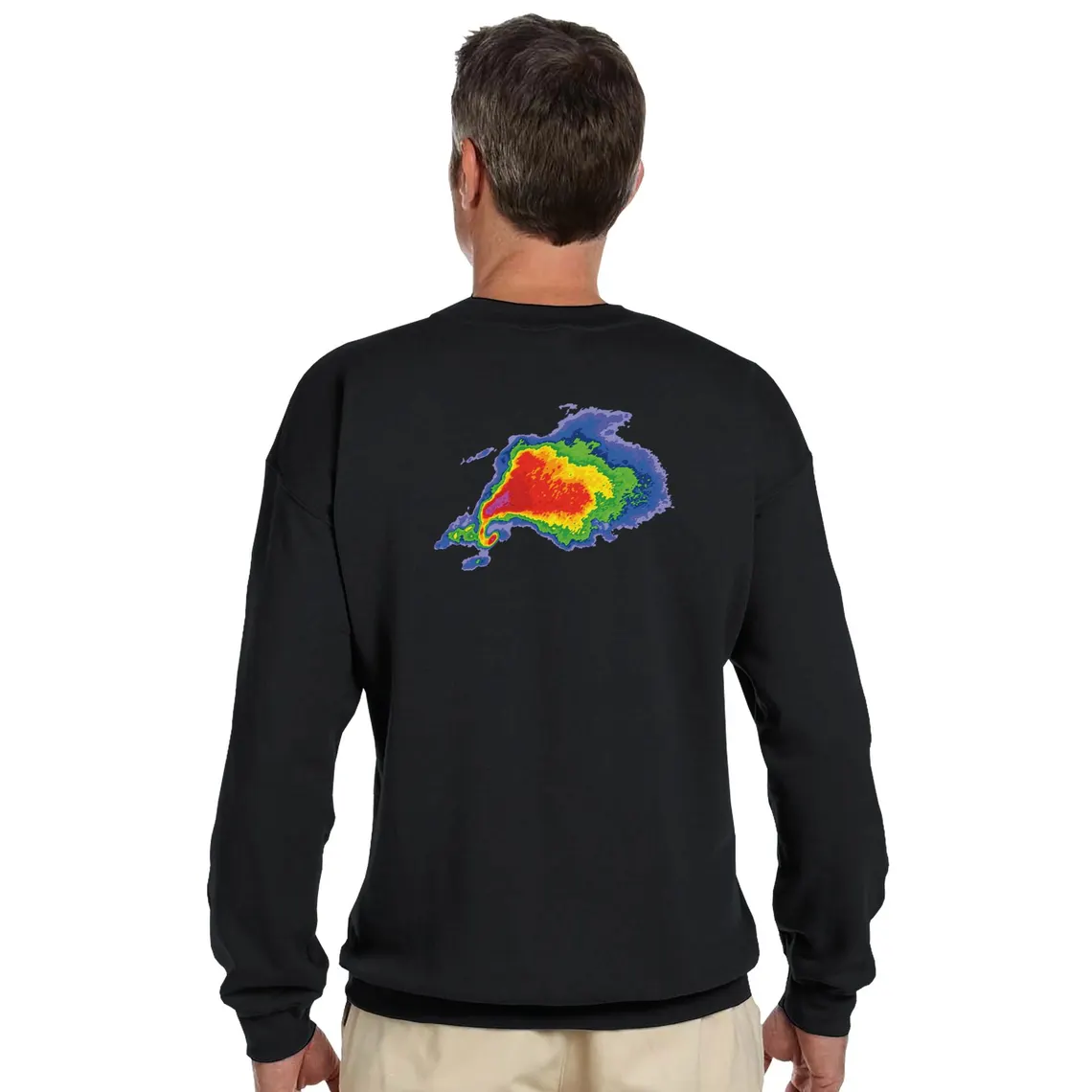
This velocity couplet is often centred at the same location as the hook echo on the reflectivity scan. The hook is the precipitation wrapping around the mesocyclone. The couplet is the rotation itself. Together they provide converging evidence of a well-organised, potentially tornado-producing storm.
Automated rotation algorithms used by the National Weather Service scan Doppler data continuously for velocity couplets meeting mesocyclone criteria. When they flag one, the duty forecaster assesses it alongside visual reports, sounding data, and the storm's broader context to decide whether to issue a tornado warning.
Why Most Mesocyclones Do Not Produce Tornadoes
Roughly 25 to 30 percent of supercell mesocyclones produce confirmed tornadoes. The majority produce everything associated with a serious severe weather event, large hail, damaging winds, intense rainfall, without ever touching down.
The transition from mesocyclone to tornado requires a secondary process near the ground. The leading theory involves the interaction between the mesocyclone, the rear flank downdraft, and the low-level horizontal vorticity of the surface boundary layer. As the RFD wraps around the mesocyclone and surges forward, it interacts with the low-level wind field. If the horizontal vorticity near the surface is tilted into the vertical and concentrated rapidly enough, surface rotation can develop and intensify into a tornado beneath the wall cloud.
What determines whether this process completes is not fully understood. The thermodynamic characteristics of the near-surface environment matter significantly. Storms moving over terrain with strong boundaries, sharp gradients in temperature and moisture, or favourable low-level wind profiles are more likely to produce tornadoes than otherwise similar storms in less favourable environments. Forecasters can identify setups where tornado production is more likely, but predicting whether any individual mesocyclone will produce a tornado remains beyond current capability.
Historical Examples
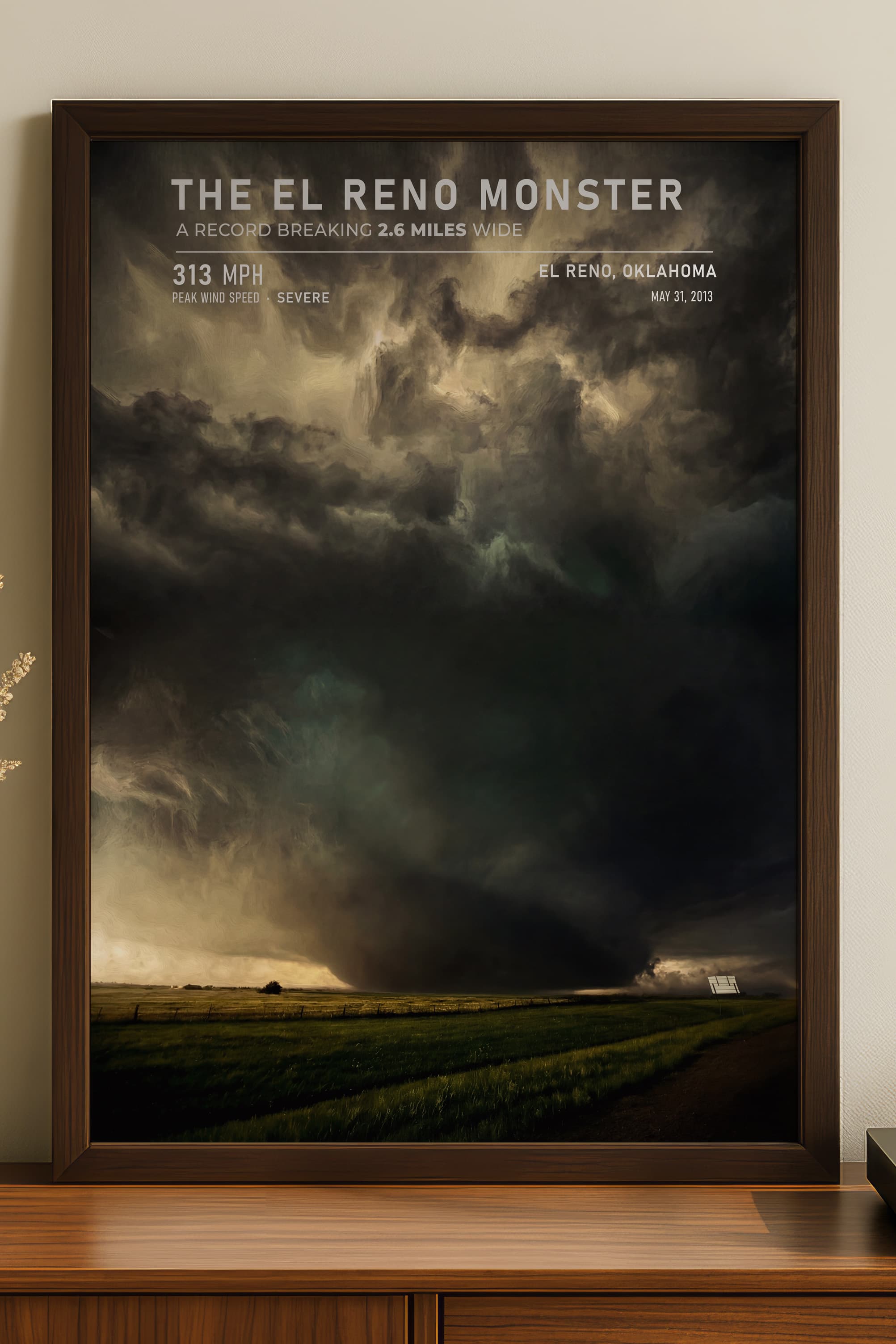
The El Reno tornado of 2013 is the most dramatic example of what a strongly organised mesocyclone can produce. The storm's mesocyclone was exceptionally large even by supercell standards, and the tornado it eventually produced reached a diameter of 2.6 miles, the widest ever recorded. Mobile radar teams measured surface wind speeds within the circulation that likely approached 300 mph. The mesocyclone that produced it was observable on operational radar for an extended period before the tornado developed.
Large mesocyclones like El Reno's do not always produce the most intense surface circulations. Storm-scale dynamics matter as much as raw size. Some of the most violent tornadoes in history were produced by relatively compact mesocyclones in environments where the low-level processes aligned precisely.
Understanding what the mesocyclone is and what it is not is central to reading supercell behaviour. It is the engine. Everything visible from the ground, from the wall cloud to the tornado itself, is a product of what the mesocyclone is doing.
Archives for storm chasers and meteorology obsessives
Museum-quality prints and technical apparel built on real data. Designed by those who chase.