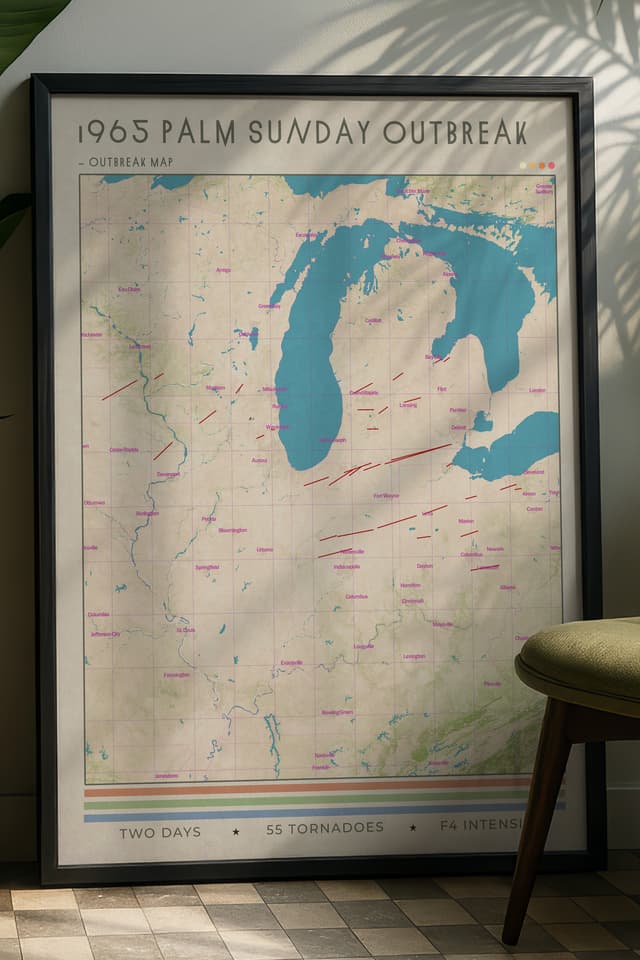
1965 Palm Sunday Tornado Outbreak
On the afternoon of Palm Sunday, April 11th, 1965, a series of violent tornadoes struck the upper Midwest. 55 confirmed tornadoes killed 266 people and injured over 3,500 across Indiana, Ohio, Michigan, and surrounding states. 18 of those tornadoes reached F4 intensity. The outbreak remains one of the deadliest in American history and was the first major tornado event analysed using the emerging tools of modern meteorology. Upper-level winds of 185 mph were recorded over Kansas by weather balloon networks, and surface temperatures reached 85°F in the warm sector ahead of the cold front.
The Meteorological Setup
A powerful low pressure system was deepening across the central plains on April 11th. Ahead of the associated cold front, warm moist air from the Gulf of Mexico had surged well into the Great Lakes region. The surface temperature and moisture profiles were extreme for that latitude and time of year. Strong southwesterly winds aloft were creating the deep-layer shear necessary for supercell development.
By early afternoon, towering cumulus was developing along and ahead of the cold front across Indiana and Ohio. The initial convection quickly organised into discrete supercells, several of which began producing tornadoes within minutes of each other.
The Tornado Families
The defining characteristic of the Palm Sunday outbreak was the concentration of violent tornadoes along parallel tracks across a relatively compact geographic area. Multiple long-track tornadoes moved through northern Indiana and lower Michigan in rapid succession, with damage paths running roughly parallel from southwest to northeast.
A defining characteristic of this outbreak was the presence of twin funnel or double tornadoes, particularly the pair that struck the Midway and Dunlap, Indiana area. These vortices moved nearly parallel to each other, creating a combined damage swath that in some areas reached four miles wide. The Sunnyside subdivision in Dunlap was struck by the second of two violent tornadoes to hit the area within an hour, resulting in 36 deaths. The concentrated casualties along these tracks reflected the density of the population and the complete absence of effective advance warning.
Communication failures meant that towns further along each tornado's path had no knowledge that a tornado was approaching despite it already being on the ground for miles. In Michigan, the Manitou Beach area saw 100 vacation cottages destroyed, though many were fortunately vacant due to the early spring date.
Several tornadoes were on the ground simultaneously during the peak of the outbreak between 5:00 PM and 8:00 PM. This simultaneous activity overwhelmed the forecasting and communication infrastructure of the era.
Ted Fujita and the Aerial Surveys
The 1965 Palm Sunday outbreak was a pivotal event for Dr Tetsuya Theodore Fujita. He conducted extensive aerial surveys of the damage paths, developing and refining the methodology he would later apply to the 1974 Super Outbreak.
Fujita's analysis of the Palm Sunday damage led to important early work on tornado families and the concept of multiple tornadoes spawned by the same parent storm system. His documentation of the parallel damage tracks helped establish the understanding that large-scale tornado outbreaks produce organised patterns of tornadoes rather than random distributions.
The aerial survey techniques developed during the Palm Sunday analysis became standard practice for post-event damage assessment. The methodology of mapping destruction from above, correlating damage intensity with wind speed estimates, and identifying tornado tracks from the air owes a significant debt to the work Fujita began with this event.
The Warning Problem
In 1965, the tornado warning system was rudimentary by modern standards. The Weather Bureau could issue tornado watches for broad areas, but individual tornado warnings for specific counties and communities were limited. There was no Doppler radar, no automated siren systems in most communities, and no mechanism for pushing warnings directly to individuals.
Many of the 266 people killed had no warning at all. Many residents confused "tornado forecasts" (watches) with "tornado warnings," leading to inadequate sheltering behaviour. The tornadoes struck during the late afternoon and evening, and several hit after dark, compounding the danger. Communities further along a tornado's path often had no knowledge that the tornado existed despite it being on the ground for considerable distances. This contrasts sharply with later events like the 1999 Oklahoma tornado outbreak, where live radar and television coverage provided significant advance warning.
What It Changed
The Palm Sunday outbreak accelerated the push for improved tornado warning dissemination across the Midwest. It demonstrated, in a way that could not be ignored, that large-scale tornado outbreaks could produce mass casualties when communities lacked the ability to receive timely warnings.
The event also established the upper Midwest as a region vulnerable to violent tornado outbreaks representing a challenge to the assumption that Tornado Alley was confined to the southern Great Plains. Indiana, Ohio, and Michigan demonstrated their capacity for F5 tornadoes on this day.
We created a Fujita-style print of the 1965 Palm Sunday Outbreak. It is in the shop.