Waterspouts Explained
Tornadoes over water. How fair-weather waterspouts differ from their tornadic cousins, where they form, and why the Florida Keys see more than anywhere else on Earth.
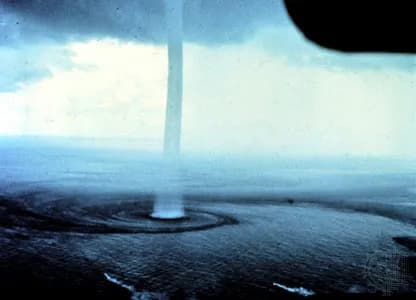
A waterspout is a rotating column of air extending from a cloud base to a water surface. The term covers two distinct phenomena that form through completely different mechanisms: tornadic waterspouts, which are tornadoes that happen to be over water, and fair-weather waterspouts, which form from the surface upward through a process unrelated to supercell thunderstorms.
Tornadic Waterspouts
A tornadic waterspout is a tornado over water. It forms in exactly the same way as a land tornado, descending from a rotating mesocyclone within a supercell thunderstorm. The only difference is the surface underneath. If a supercell moves over a lake, a bay, or a coastal area and produces a tornado, that tornado is classified as a waterspout for as long as it is over water. If it makes landfall, it becomes a tornado. The actual visible shape can take on many different tornado types, from rope to wedge. The full mechanics of how tornadoes form apply equally to tornadic waterspouts.
Tornadic waterspouts can be violent. They carry the same intensity potential as any other tornado, meaning they theoretically could reach F5 damage like the Elie, Manitoba tornado if they struck land. Coastal communities have experienced significant damage from tornadic waterspouts that developed over water and then moved onshore.
Fair-Weather Waterspouts
Fair-weather waterspouts are the more common type and form through a fundamentally different mechanism. They develop from the surface upward, usually beneath innocuous-looking cumulus congestus clouds rather than severe thunderstorms.
The formation process begins with a boundary layer convergence zone over warm water. When two airmasses converge at the surface, the resulting uplift concentrates existing low-level rotation into a tight column. This rotation tightens and extends upward toward the cloud base above. The visible funnel forms as the pressure drop within the rotating column causes water vapour to condense, making the vortex visible.
Fair-weather waterspouts are typically weaker than tornadic waterspouts. Most are equivalent to EF0 or EF1 on the Enhanced Fujita Scale if they were to make landfall. They tend to be narrow, short-lived, and slow-moving. They dissipate quickly when they encounter land because the friction of the surface disrupts the low-level rotation that sustains them.
The Lifecycle
A fair-weather waterspout progresses through five recognised stages described by Dr Joseph Golden in his research during the 1970s.
The dark spot stage is the earliest visible indicator: a light-coloured disc appears on the water surface where the vortex is beginning to concentrate rotation.
The spiral pattern stage shows bands of darker water spiralling inward toward the centre of the developing vortex.
The spray ring stage occurs when the rotation is strong enough to lift a ring of spray from the water surface around the base of the vortex.
The mature stage is when the waterspout reaches maximum intensity, with a visible funnel extending from the cloud base to the water surface and a spray vortex at the base.
The decay stage occurs when the inflow of warm, moist air weakens and the waterspout dissipates from the bottom upward.
Where They Form
The Florida Keys produce more waterspouts than any other location on Earth. The warm, shallow waters surrounding the Keys, combined with frequent convergence boundaries from land and sea breeze interactions, create conditions that are so favourable that multiple waterspouts can form simultaneously during the summer months.
The Great Lakes produce waterspouts regularly, particularly during autumn when the surface water is still warm but the air above is cooling. The temperature contrast between the warm lake surface and the cooler air promotes the instability and convergence that fair-weather waterspouts require.
The Mediterranean, the Adriatic, the seas around Japan, and the coastal waters of Australia all produce waterspouts regularly when the atmospheric and oceanic conditions align.
The Distinction Matters
The difference between tornadic and fair-weather waterspouts is not just academic. Tornadic waterspouts require severe thunderstorm warnings and potentially tornado warnings. Fair-weather waterspouts, while they warrant marine warnings, are not associated with severe thunderstorms and present a fundamentally different threat profile. The treatment of the two types in forecasting and warning operations is different because the formation mechanisms, intensities, and associated hazards are different.
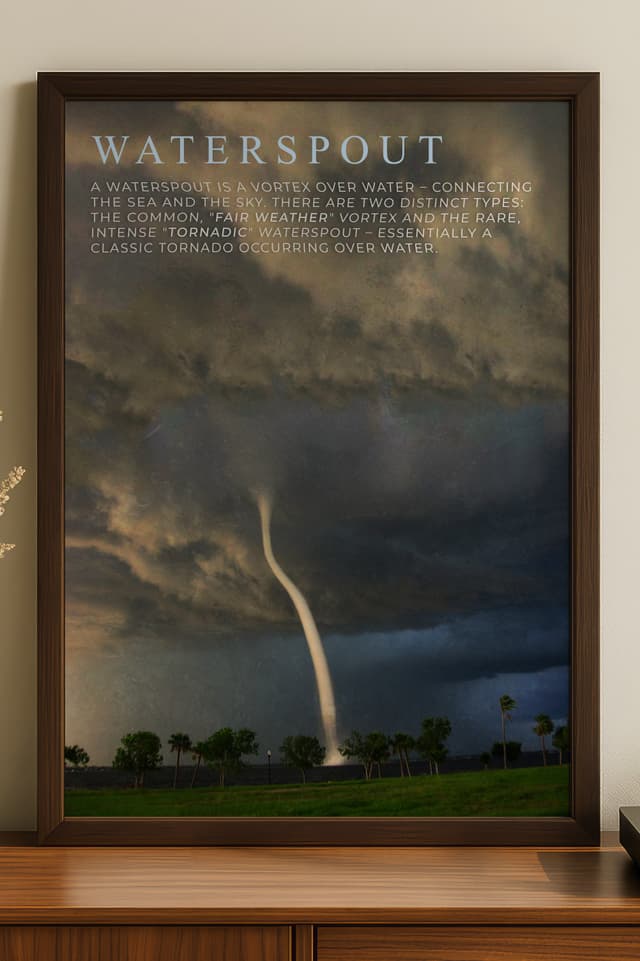
We have an oil-painted style waterspout print. It is in the shop.
Archives for storm chasers and meteorology obsessives
Museum-quality prints and technical apparel built on real data. Designed by those who chase.