What Are Lenticular Clouds?
The smooth, lens-shaped clouds that form over mountains and get mistaken for spacecraft. How standing waves in the atmosphere create one of the most visually striking phenomena in meteorology.
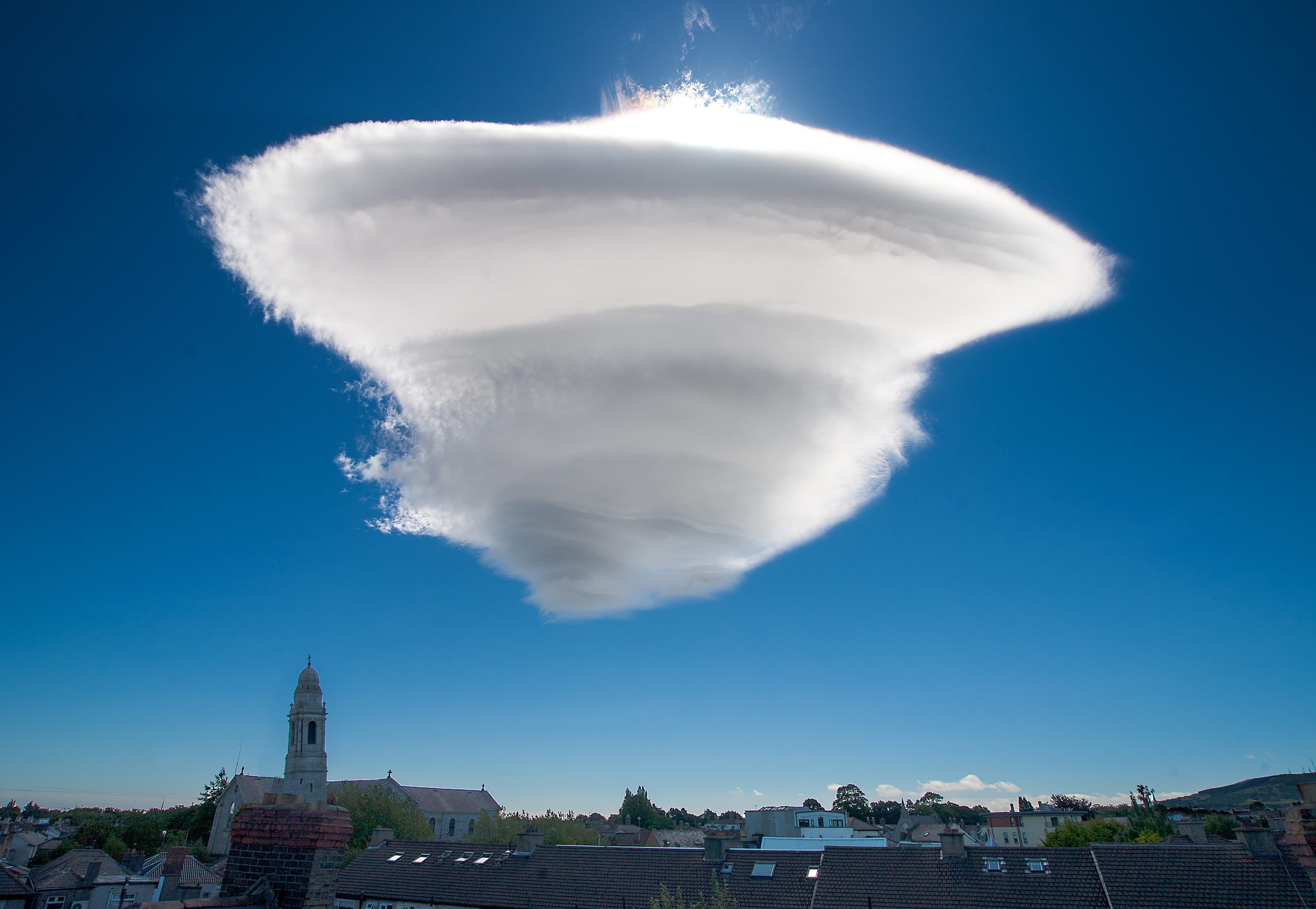
Lenticular clouds are smooth, lens-shaped or saucer-shaped cloud formations that develop in the lee of mountains and elevated terrain. They form when stable, moist air flows over a topographic barrier and is forced into a standing wave pattern. The cloud forms at the crest of each wave where the air cools to its dewpoint, and dissipates on the descending side where the air warms again. The result is a cloud that appears to hover motionless over the terrain below, even as wind moves through it continuously.
How They Form
The formation mechanism is straightforward but requires specific atmospheric conditions. When a stable layer of air encounters a mountain range, it is deflected upward. If the atmosphere is sufficiently stable, the displaced air does not keep rising. Instead, it oscillates up and down in a wave pattern downwind of the obstacle, similar to ripples on a river downstream of a submerged rock.
At the crest of each wave, the air rises just enough to cool below its dewpoint and condense into cloud. At the trough, the air descends and warms, causing the cloud to evaporate. Because the wave pattern is stationary relative to the terrain, the cloud appears fixed in place even though air is constantly flowing through it.
The technical name for these formations is altocumulus lenticularis, or altocumulus standing lenticular when formed in mountain wave conditions. They typically occur at altitudes between 6,500 and 16,000 feet, depending on the height of the terrain and the atmospheric moisture profile. For an example of an unusual cloud type with a completely different and less predictable formation mechanism, asperitas clouds were only formally classified in 2017.
Why They Look That Way
The smooth, disc-like shape is a product of the laminar airflow within the standing wave. Unlike the turbulent convective processes that produce cumulus and cumulonimbus clouds, such as those forming supercells or even the boundary layer instability of a dust devil, the airflow within a mountain wave is smooth and layered. This laminar flow produces the clean, sharp edges and sculpted surfaces that make lenticular clouds visually distinctive.
In strong wave conditions, multiple lenticular clouds can stack on top of each other in a formation called a pile d'assiettes, or stack of plates. This occurs when several layers of moist air at different altitudes are all oscillating in the same wave pattern, each producing its own lens-shaped cloud.
Where to See Them
Lenticular clouds form wherever there are mountains and the right atmospheric conditions. They are particularly common and well-known in the following regions:
The Sierra Nevada and the Cascade Range in the western United States produce frequent lenticular formations, particularly during winter and spring when strong westerly winds interact with the terrain.
Mount Rainier in Washington state is one of the most photographed locations for lenticular clouds. The isolated volcanic peak creates a clean wave pattern that frequently produces a single, dramatic disc-shaped cloud hovering directly above the summit.
The Southern Alps of New Zealand produce lenticular formations that are routinely spectacular, often stacking in multiple layers against deep blue skies.
Scotland and the Lake District in the UK produce lenticular clouds when moist Atlantic airflow interacts with the elevated terrain, though they occur less frequently than in more mountainous regions.
Aviation Significance
Lenticular clouds are not just visually interesting. They are significant indicators for pilots. The standing wave conditions that produce lenticular clouds also produce severe turbulence, particularly on the downwind side of the mountain ridge. The rotors beneath the wave crests can produce violent, low-level turbulence that is dangerous to aircraft. Glider pilots, conversely, actively seek out mountain wave conditions because the strong, sustained uplift in the ascending part of the wave allows extended soaring flights.
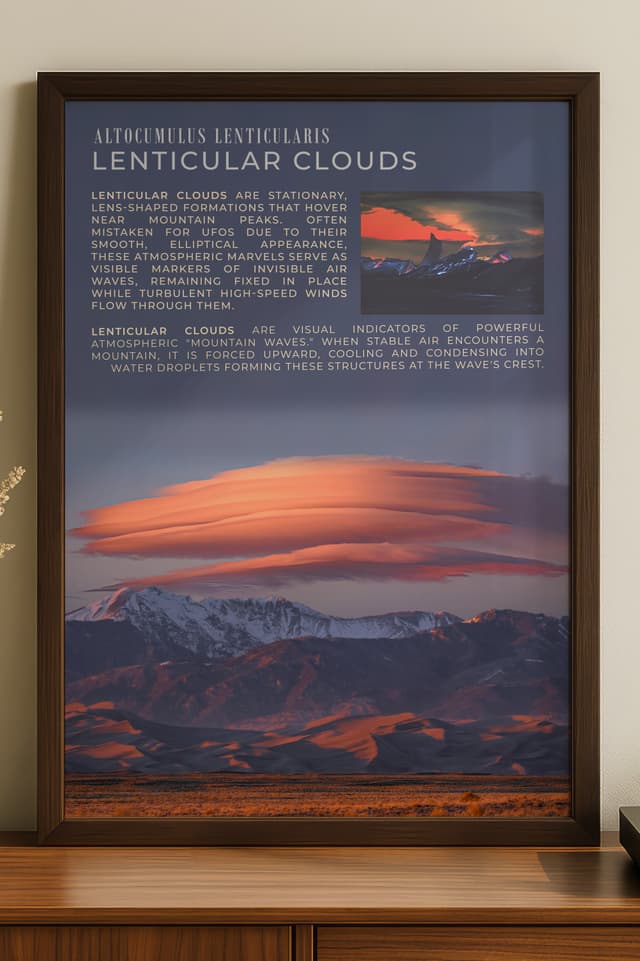
We made a retro-style lenticular cloud print. It is in the shop.
Archives for storm chasers and meteorology obsessives
Museum-quality prints and technical apparel built on real data. Designed by those who chase.