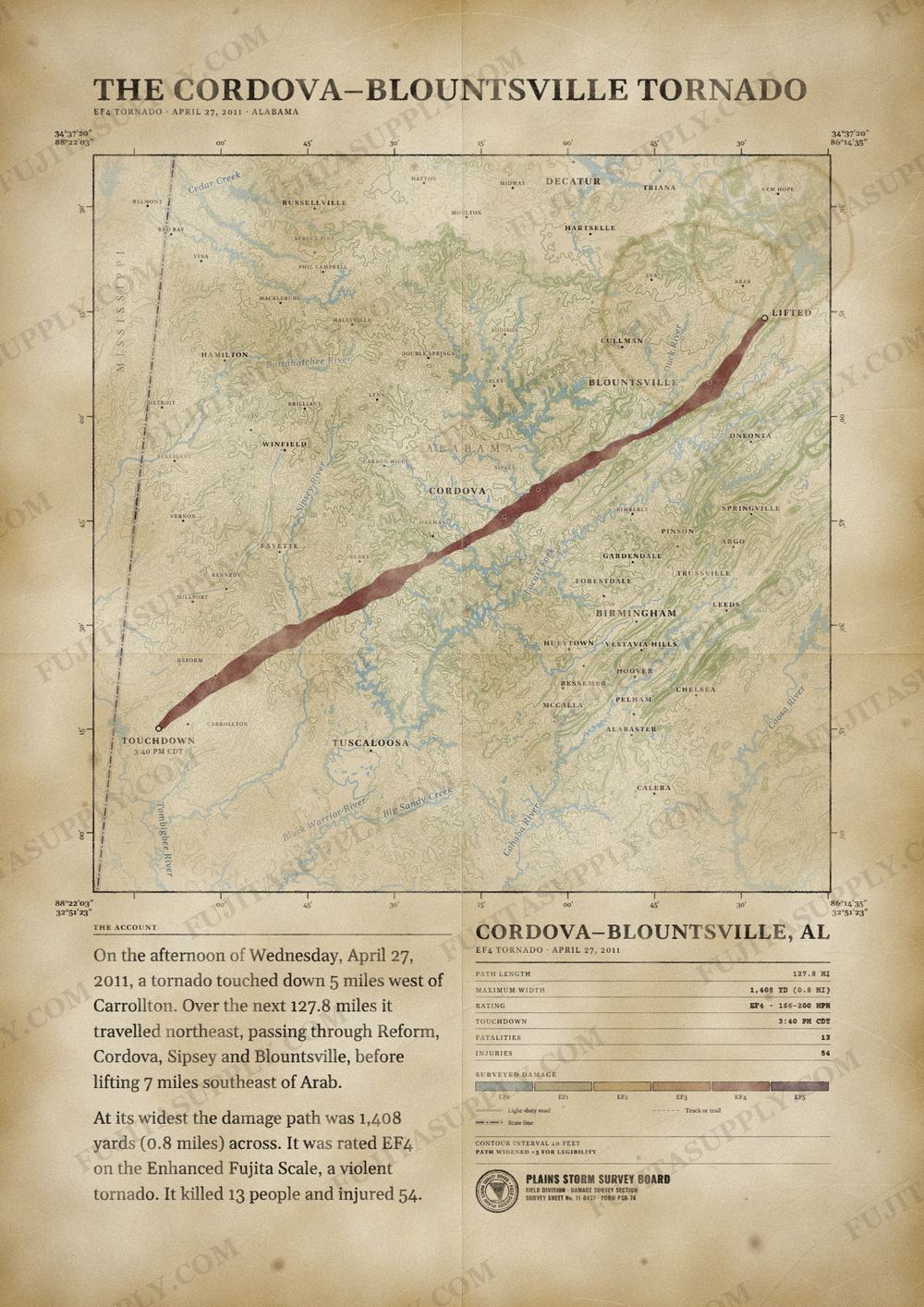
Cordova-Blountsville Tornado Map
In the afternoon hours of April 27, 2011, a large, long-tracked and violent EF4 tornado, known as the Cordova tornado, moved across Central Alabama, devastating several communities, including Cordova and Blountsville. The tornado killed 13 and had a maximum width of 1,408 yards (0.800 mi). It occurred as part of the largest tornado outbreak in modern history and was one of eleven EF4 tornadoes to strike the Southern United States on April 27. The tornado was the longest-tracked of the outbreak, carving a 127.8-mile (205.7 km) path of damage through seven counties.
The path of the Cordova-Blountsville tornado
On the afternoon of Wednesday, April 27, 2011, a tornado touched down 5 miles west of Carrollton. Over the next 127.8 miles it traveled northeast, passing through Reform, Cordova, Sipsey and Blountsville, before lifting 7 miles southeast of Arab.
At its widest the damage path was 1,408 yards (0.8 miles) across. It was rated EF4 on the Enhanced Fujita Scale, a violent tornado. It killed 13 people and injured 54.
The track, widths and figures on this map come from the Storm Prediction Center's survey record, so they can differ slightly from totals published elsewhere.
What was the Cordova tornado?
The Cordova tornado was a violent, long-tracked EF4 storm that struck Central Alabama on the afternoon of April 27, 2011. It formed as part of a massive tornado outbreak and devastated several communities, including Cordova and Blountsville. The tornado remained on the ground for over two hours and carved a path through seven counties. It caused catastrophic damage to homes and infrastructure, resulting in 13 fatalities.
What was the Cordova tornado wind speed?
The National Weather Service rated the storm as a low-end EF4 tornado with maximum winds reaching 170 mph (270 km/h). Investigators determined this intensity based on the structural damage observed along the path, including the obliteration of homes and the tossing of heavy vehicles. This wind speed corresponds with the destruction of well-built homes and the uprooting of large trees across the Alabama landscape.
What was the Cordova tornado path?
The tornado touched down at 3:40 p.m. CDT in northeastern Pickens County. It traveled 127.8 miles (205.7 km) across Alabama through seven different counties. The track moved through Cordova and Blountsville before the storm eventually dissipated south-southwest of Guntersville at 5:56 p.m. CDT. This lengthy path spanned over two hours of total time on the ground.
How many people died in the Cordova tornado?
The tornado caused a total of 13 fatalities across its path. Four of these deaths occurred directly within the downtown area of Cordova when a home was destroyed. Additional fatalities occurred in other impacted areas as the storm struck mobile homes and residential structures. The violent nature of the EF4 intensity contributed to these casualties throughout the affected counties.
What did the Cordova tornado destroy?
The tornado leveled site-built homes and obliterated numerous mobile homes. In Cordova, it destroyed the city hall, a Piggly Wiggly grocery store, and at least one Methodist church. It also tossed heavy machinery, including a 5-ton bulldozer and a 2-ton trailer that traveled one mile. Furthermore, the storm snapped and uprooted thousands of trees and knocked down a cell phone tower.
What caused the Cordova tornado?
The tornado resulted from a highly unstable atmosphere characterized by extreme wind shear and ample Gulf of Mexico moisture. A deep, negatively tilted trough over Arkansas and Louisiana combined with a strong surface low over Kentucky to fuel the activity. The Storm Prediction Center reported storm-relative helicity values exceeding 500 m2s-2, which indicated a very high potential for rotating supercell updrafts. Daytime temperatures reached 81 °F and CAPE values surged to 3,000 J/kg-1.
What happened after the Cordova tornado?
Recovery efforts persisted for months as Cordova managed the aftermath of two separate tornadoes hitting the town in one day. The city received over $5 million in aid, while Blount County received $758,572. A city-wide ordinance prohibiting FEMA trailers within Cordova city limits sparked significant national controversy. Meanwhile, authorities fenced off the downtown area to prevent trespassing and manage the site of the destruction.

Frequently Asked Questions
How many EF4 tornadoes hit on April 27, 2011?
What was the path width of the Cordova tornado?
Did Cordova experience other tornadoes that day?
When did the Cordova tornado lift?
Was the TIV 1 at the Cordova–Blountsville tornado?
Was the Dominator at the Cordova–Blountsville tornado?
Citations
Related Tornadoes
Chickasha-Blanchard Tornado
Grady County, McClain County, Cleveland County
Cullman-Arab Tornado
Cullman, Fairview, Arab, Ruth, Cullman County, Morgan County, Marshall County, Alabama
El Reno-Piedmont Tornado
El Reno, Piedmont, Guthrie, Canadian County, Kingfisher County, Logan County
St. Louis-East St. Louis Tornado
Missouri, Illinois