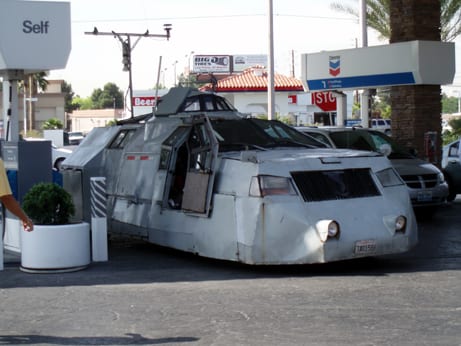

The TIV 1 is the original Tornado Intercept Vehicle, an armored 1997 Ford truck that IMAX filmmaker Sean Casey built in 2003 to film tornadoes from inside them. Today it belongs to Wichita storm chaser Robert Clayton, who won it in a scavenger hunt, and it is being restored in Kansas.
Where is the TIV 1 now?
The TIV 1 is with Robert Clayton in Kansas, partway through a restoration. In April 2025 he moved it out of Augie's Towing and Repair in Hays, Kansas, and started taking weight off it. The front bumper, the claws and the trunk have come off, and the body is being repainted black. In July 2026 he posted that it was being prepped for paint and a bed liner coating. Clayton posts the work on TikTok as @r.clayton92.
No sale or asking price for the TIV 1 has been reported since Clayton took it over. The only figure on record is the roughly $81,000 it cost to build.
How did the TIV 1 end up in a Kansas yard?
When Storm Chasers ended in 2011, Casey no longer needed the TIV 1. He parked it in a yard in Liebenthal, a small town in central Kansas, and made it the prize in a scavenger hunt. Clues went online, and the first person to find the truck could keep it.
It sat there for about ten years. The landowner knew the truck was on the property but did not know it was a prize. Clayton followed the clues and then went looking on Google Earth. "We found it on Google Earth in some dude's yard," he told KSN. "Per his rules, I own TIV now."
Clayton has owned it since at least September 2020. The story became news in March 2022, when KSN reported the find and his plan to restore it.
What is the TIV 1 built on?
The TIV 1 is built on a 1997 Ford F-Super Duty cab and chassis, usually described as an F-450. It has a 7.3 liter Powerstroke turbo diesel and a five-speed manual gearbox. It has four wheels and two-wheel drive, which left it easy to get stuck on wet dirt roads.
The body is 1/8 to 1/4 inch steel plate welded onto a frame of 2 inch square steel tubing. The windshield is 1.5 inch bullet-resistant polycarbonate, and the side windows are 0.5 inch polycarbonate. The truck stands about 14 feet tall, carries 60 gallons of fuel for a range of about 500 miles, and tops out at 80 mph.
How much does the TIV 1 weigh?
The TIV 1 weighs about 14,000 pounds loaded. Casey said in 2005 that he had welded about 8,000 pounds of steel onto the truck, so more than half its weight is armor.
When was the TIV 1 made?
Work on the TIV 1 started in December 2002 and took about eight months, so it was finished in 2003. It cost about $81,000. The money covered the Ford chassis, the steel and polycarbonate, and the rotating roof turret built to carry a 70mm IMAX camera.
How the TIV 1 changed over the years
The truck was changed several times between 2003 and today. These are the changes we could date.
- 2003. Finished as an armored truck with an IMAX camera turret on the roof that turns 360 degrees. Instead of anchors, the body could be lowered flush with the road so wind could not get under it.
- 2005. The TIV 1 intercepted a tornado near Jayton, Texas, on June 12, 2005. That year he also worked with Joshua Wurman's Doppler on Wheels team, whose radar guided the TIV toward a tornado for the National Geographic series Twisted. By December 2005, Casey said police had pulled the truck over 34 times in three years.
- After May 2006. Four hydraulic claws were added. Before an intercept they were driven down into the ground to hold the truck in place. The photo at the top of this page shows it just before that change.
- 2007. Storm Chasers premiered on the Discovery Channel in October 2007 with the TIV 1 as Casey's vehicle.
- 2008 to 2011. Casey built a replacement in 2008, but the TIV 1 came back to finish the start of that season when the new truck broke down. It stayed on as a backup vehicle through 2011.
- About 2011 to 2020. Parked in the Liebenthal yard as the scavenger hunt prize.
- 2022 to 2025. At Augie's Towing and Repair in Hays, where it had been worked on under its earlier owners. Cole Pfiefer started the restoration there with Clayton.
- 2025 to 2026. Back with Clayton. Bumper, claws and trunk removed, old paint stripped, and the body prepared for black paint and a bed liner coating.
What were the TIV 1 claws for?
The claws were four hydraulic arms on the sides of the truck. Before a tornado arrived, the crew lowered them into the ground so the wind could not slide or roll the truck. They were added after the first few seasons. Clayton removed them in 2025 and plans to fit hydraulic anchors that lower the truck to the ground in strong wind.
How strong a tornado could the TIV 1 survive?
The TIV 1 was built for tornadoes rated EF0 to EF3. Casey put the limit plainly in 2005: "We're OK with a light tornado, winds up to 150 miles per hour." Above that, he said, "this thing will be picked up and deposited somewhere else."
What is planned for the TIV 1?
Clayton's first goals are that it runs well, is safe, and can stop and turn. The plan he described to KSN includes reworking the engine, upgrading the windows, lining the sheet metal, and adding the hydraulic anchors. He also wants to fit instruments to record weather data at ground level.
The TIV 1 is one of about twenty vehicles built to go after tornadoes. Our list of every tornado interceptor covers the rest, and our gift list for storm chasers has picks for anyone who followed the show.