Tri-State Tornado Map
The 1925 Tri-State tornado holds the record for the longest path length of any tornado, tracking 219 miles across three states. It remains the deadliest single tornado in United States history, killing 695 people and destroying multiple towns.
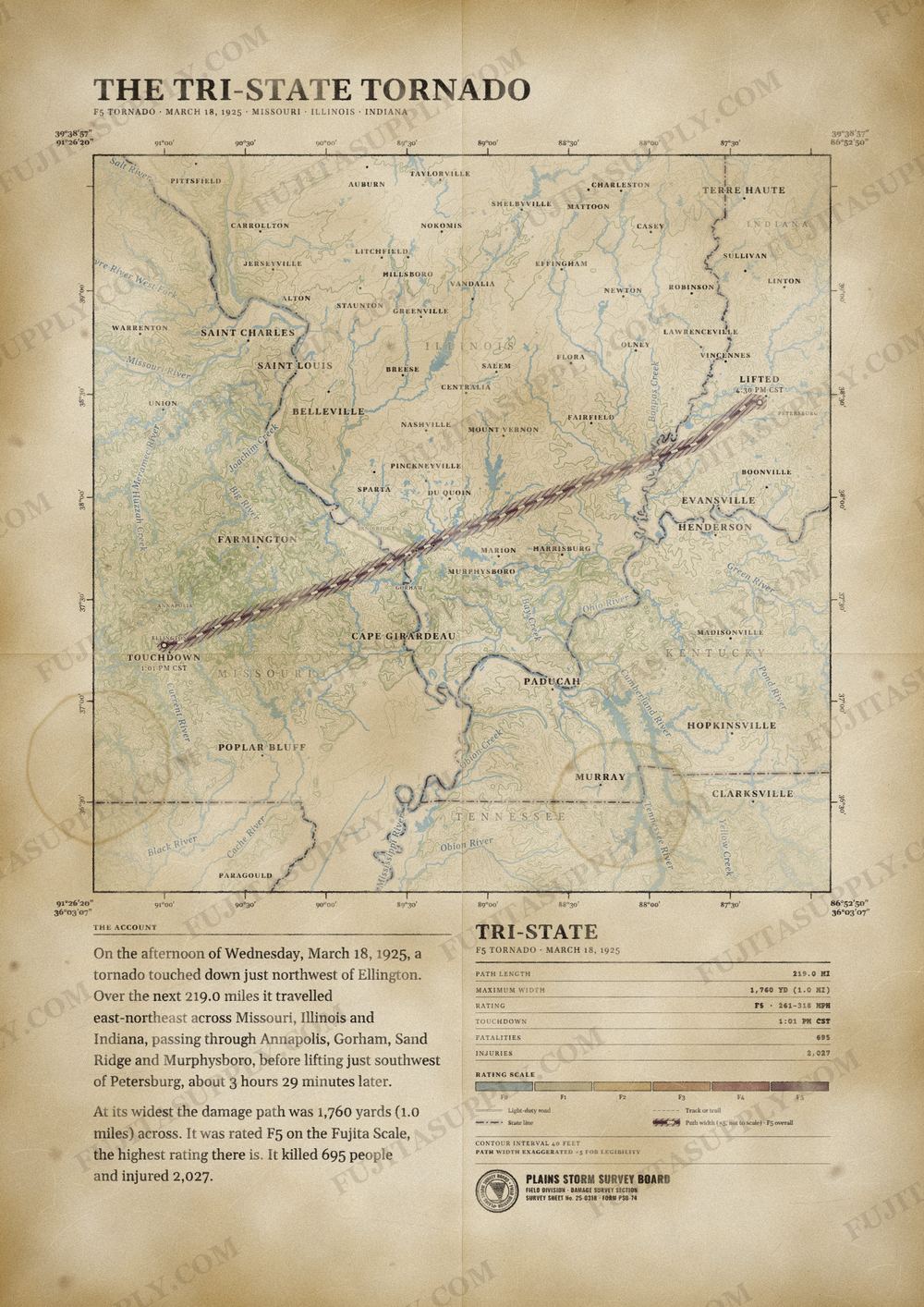
The path of the Tri-State tornado
On the afternoon of Wednesday, March 18, 1925, a tornado touched down just northwest of Ellington. Over the next 219.0 miles it traveled east-northeast across Missouri, Illinois and Indiana, passing through Annapolis, Gorham, Sand Ridge and Murphysboro, before lifting just southwest of Petersburg, about 3 hours 29 minutes later.
At its widest the damage path was 1,760 yards (1.0 miles) across. It was rated F5 on the Fujita Scale, the highest rating there is. It killed 695 people and injured 2,027.
The track, widths and figures on this map come from the historical record of this pre-1950 tornado, so they can differ slightly from totals published elsewhere.
What was the Tri-State tornado?
The Tri-State tornado was a catastrophic F5 vortex that struck Missouri, Illinois, and Indiana on March 18, 1925. It remains the deadliest tornado in United States history. The storm maintained a continuous path on the ground for three and a half hours. It traveled at an average forward speed of 62 mph and reached a record 73 mph. The massive system devastated multiple mining towns and farming communities across the three states.
What was the Tri-State tornado wind speed?
Meteorologists estimated the peak wind speed of the Tri-State tornado at 261 mph to 318 mph. This velocity placed the storm in the F5 category on the Fujita scale. The intense winds caused catastrophic damage to steel-reinforced concrete buildings and strong wood-framed houses. The tornado maintained a uniform width of three-quarters of a mile for over 100 miles. It advanced as a boiling mass of clouds rather than a widely visible funnel.
What was the Tri-State tornado path?
The Tri-State tornado path began northwest of Ellington, Missouri, at 12:40 p.m. CST. It traveled 219 miles in a straight line toward the northeast. The vortex crossed the Mississippi River into Jackson County, Illinois, at 2:25 p.m. CST. It moved through Williamson, Franklin, Hamilton, and White counties before entering Indiana. The storm finally dissipated near Princeton, Indiana, about a half-hour after 4:00 p.m. CST.
How many people died in the Tri-State tornado?
The Tri-State tornado killed 695 people and injured 2,027 others. Illinois suffered the highest casualties with over 600 fatalities. The storm claimed 234 lives in Murphysboro, which remains the largest single-community death toll from a tornado in United States history. The town of West Frankfort recorded 148 deaths and 410 injuries. Indiana reported 71 fatalities, while at least 11 people died in Missouri.
What did the Tri-State tornado destroy?
The Tri-State tornado destroyed thousands of structures and caused $16.5 million in property damage. It demolished 40 percent of the buildings in Murphysboro, including three elementary schools, a high school, and railroad shops. The storm leveled virtually all of Gorham and devastated the communities of De Soto, Bush, and Parrish. In Indiana, the vortex destroyed 150 homes in Griffin and devastated 85 farms before destroying half of Princeton.
What caused the Tri-State tornado?
The Tri-State tornado originated from a cyclonic storm system that developed over the northeast Pacific Ocean. This depression moved over western Montana on March 16 before centering in northwestern Arkansas on the morning of March 18. The system produced an environment that spawned seven distinct tornadoes that day. The primary vortex followed a topographic ridge associated with mineral resources. Massive amounts of dust and debris obscured the storm as it advanced.
What happened after the Tri-State tornado?
Following the Tri-State tornado, the American Red Cross compiled lists of the dead and injured to manage the mass casualties. Local ministers held ecumenical memorial services to comfort survivors in the devastated communities. The unprecedented destruction highlighted the lack of advance warning capabilities at the United States Weather Bureau. This disaster eventually paved the way for a formal tornado warning program.