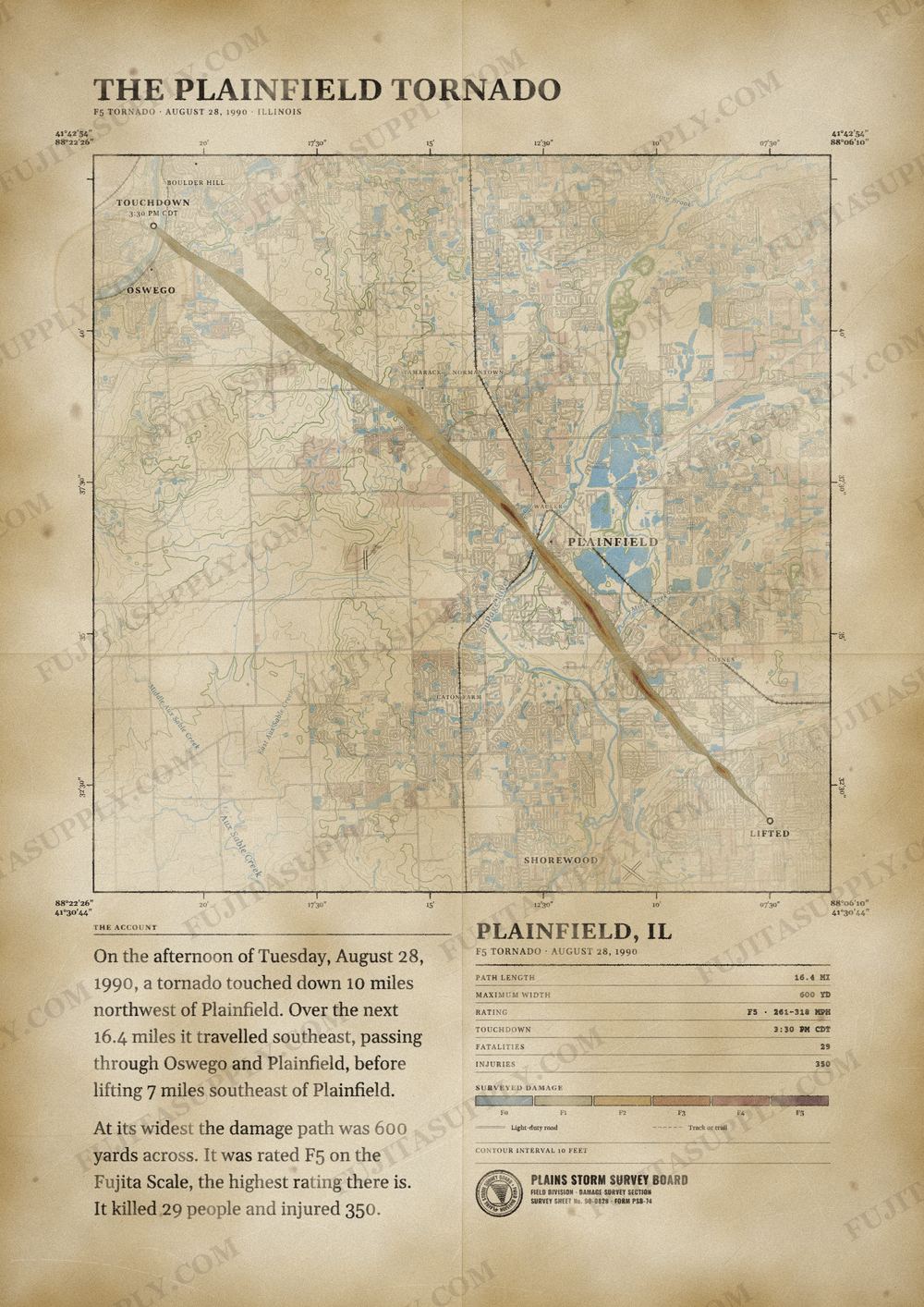
Plainfield Tornado Map
The 1990 Plainfield tornado was a devastating tornado that struck Plainfield, Illinois in the Chicago metropolitan area during the afternoon of August 28, 1990. The violent tornado killed 29 people and injured 353. It is the only F5/EF5 rated tornado officially recorded in August in the United States (the 1883 Rochester, Minnesota tornado is unofficially considered an F5), and the only F5 tornado to strike the Chicago area. There are no known videos or photographs of the tornado itself; however, in 2011, a video surfaced online showing the supercell that spawned the tornado. The Plainfield tornado was part of a small outbreak that produced several tornadoes in the Northern United States, specifically Kansas, and the Canadian province of Ontario.
The path of the Plainfield tornado
On the afternoon of Tuesday, August 28, 1990, a tornado touched down 10 miles northwest of Plainfield. Over the next 16.4 miles it traveled southeast, passing through Oswego and Plainfield, before lifting 7 miles southeast of Plainfield.
At its widest the damage path was 600 yards across. It was rated F5 on the Fujita Scale, the highest rating there is. It killed 29 people and injured 350.
The track, widths and figures on this map come from the Storm Prediction Center's survey record, so they can differ slightly from totals published elsewhere.
What was the Plainfield tornado?
The Plainfield tornado was a violent F5 event that struck the Chicago metropolitan area on the afternoon of August 28, 1990. It moved in an abnormal southeast direction rather than the conventional northeast path common for storms in this region. The tornado killed 29 people and injured 353 others during its path through Northern Illinois. It remains the only officially recorded F5 tornado in the United States during the month of August.
What was the Plainfield tornado wind speed?
The Plainfield tornado reached peak wind speeds in excess of 261 mph (420 km/h). Meteorologists assigned an F5 rating based on the intensity of the ground scouring observed in open farmland. The storm completely stripped mature corn crops from the fields and removed several inches of topsoil. These extreme ground effects served as the primary indicator for the maximum wind intensity of the vortex.
What was the Plainfield tornado path?
The principal tornado touched down near Oswego in Kendall County at approximately 3:15 p.m. It tracked southeast for 16 miles (26 km) through Will County. The storm passed through Plainfield, Crest Hill, and portions of Joliet. The parent supercell eventually dissipated near the Indiana border around 4:30 p.m. that evening.
How many people died in the Plainfield tornado?
The Plainfield tornado claimed 29 lives and injured 353 people throughout its track. Nine victims died in Plainfield, including staff and students at the local high school. Additional fatalities occurred in the Crest Hill and Joliet areas. One survivor succumbed to carbon monoxide poisoning after the storm while guarding his home, bringing the total count to 29.
What did the Plainfield tornado destroy?
The tornado demolished the Plainfield High School gymnasium and the Plainfield School District Administration building. It ripped into the St. Mary Immaculate Church and school, killing three people. Across the impacted communities, the storm destroyed hundreds of homes in subdivisions including Wheatland Plains, Crystal Lawns, and Lily Cache. The tornado also destroyed a Crest Hill apartment complex, leaving those structures in ruins.
What caused the Plainfield tornado?
A high-precipitation supercell thunderstorm triggered the tornadic event after forming in south-central Wisconsin. The atmosphere contained extreme instability with CAPE values exceeding 8,000 J/kg and LI values between -12 and -14. Dew points soared into the upper 70s °F, creating a muggy, capped environment. The approach of a low-pressure system provided the necessary cooling and dynamic lifting to initiate explosive thunderstorm development.
What happened after the Plainfield tornado?
The lack of timely warnings prompted significant advancements in radar technology and the deployment of NEXRAD. The National Weather Service subsequently reorganized its office structure, creating new forecast offices in Romeoville and Lincoln to reduce the heavy workload of the Chicago branch. Schools implemented regular, frequent tornado drills to improve preparedness. Meteorologists also developed the 'Plainfield Syndrome' concept, which prioritizes issuing warnings to avoid missing critical weather threats.
