Jarrell Tornado Map
The May 27, 1997, Jarrell tornado is widely considered one of the most violent and anomalous atmospheric events in recorded history. Touching down in Central Texas, this devastating F5 tornado obliterated the Double Creek Estates subdivision, leaving behind a level of catastrophic destruction rarely seen even among F5-rated storms. What made the Jarrell tornado so uniquely terrifying was its unusually slow forward progression; the storm crawled across the landscape, at times moving at just 5 to 10 mph. Because it lingered over the exact same locations for several minutes, the 260+ mph rotational winds essentially ground entire homes, vehicles, and paved asphalt into dust, sweeping concrete foundations completely bare. Beyond its meteorological anomalies, the Jarrell tornado is deeply entrenched in storm chasing lore due to the infamous "Dead Man Walking" photograph. Captured as the multi-vortex tornado was gathering strength, the image shows the main funnel accompanied by secondary suction vortices that eerily resemble a giant, shadowy figure walking across the plains. According to weather folklore, witnessing the "Dead Man Walking" configuration means you are looking at an unsurvivable storm. It is a myth that became a horrific reality as the slow-moving vortex claimed 27 lives.
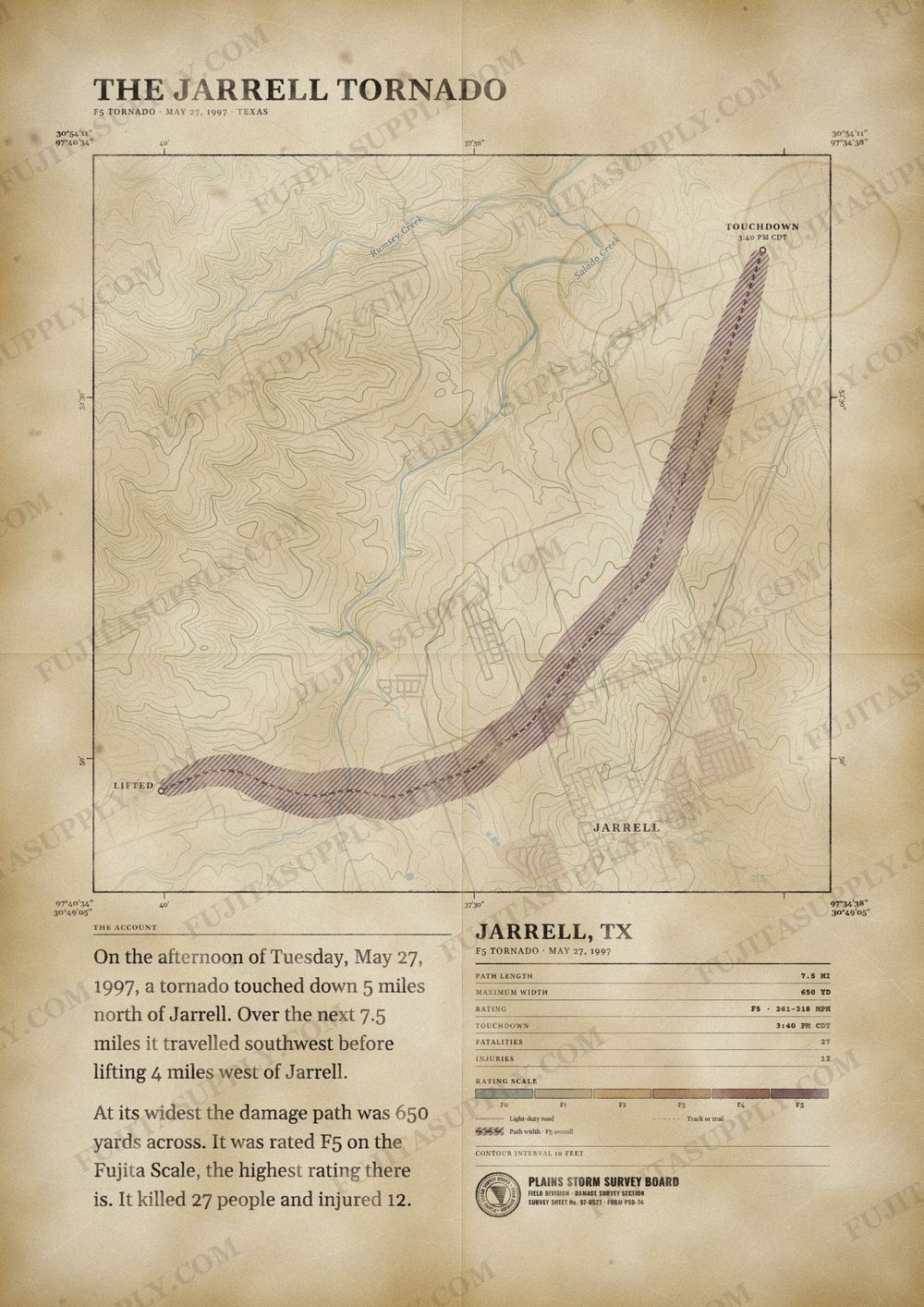
The path of the Jarrell tornado
On the afternoon of Tuesday, May 27, 1997, a tornado touched down 5 miles north of Jarrell. Over the next 7.5 miles it traveled southwest before lifting 4 miles west of Jarrell.
At its widest the damage path was 650 yards across. It was rated F5 on the Fujita Scale, the highest rating there is. It killed 27 people and injured 12.
The track, widths and figures on this map come from the Storm Prediction Center's survey record, so they can differ slightly from totals published elsewhere.
What was the Jarrell tornado?
The Jarrell tornado ranks as one of the most devastating F5 storms in history, striking Jarrell, Texas, on May 27, 1997. What made this tornado exceptionally destructive was its slow forward speed. It crawled at just 5 to 10 mph, which allowed its 261 mph rotational winds to grind homes, vehicles, and asphalt completely into the earth. The storm is also infamous for the 'Dead Man Walking' photograph, a multi-vortex phase that eerily resembled a grim reaper walking across the plains. This intense vortex serves as a primary example of extreme tornado power, resulting in 27 fatalities before dissipating.
What was the Jarrell tornado wind speed?
The Jarrell tornado produced maximum recorded wind speeds of 261 mph, or 420 km/h. These velocities classify the event as an F5 on the Fujita scale. Such speeds indicate the extreme rotational force generated by the storm. This intensity accounts for the catastrophic nature of the damage in Texas. Experts categorize these winds among the most powerful ever documented.
What was the Jarrell tornado path?
The Jarrell tornado traveled a total path length of 7.6 miles, which translates to 12.2 kilometers. It remained on the ground in the Jarrell, Texas, area. The storm formed and dissipated entirely on May 27, 1997. Its trajectory cut through the region, impacting local landscapes and properties. This specific track length captures the limited but intense duration of the storm.
How many people died in the Jarrell tornado?
The Jarrell tornado caused 27 fatalities during its passage through the area. Emergency responders also documented 12 injuries among the local population. These figures reflect the direct human cost of the F5 storm. The event remains one of the most lethal in regional history. Authorities finalized these numbers following the immediate aftermath of the disaster.
What did the Jarrell tornado destroy?
The Jarrell tornado inflicted severe destruction, resulting in total damage costs of USD 20 million. The storm impacted structures throughout the affected portions of Jarrell, Texas. Given its F5 rating, the vortex demolished infrastructure and local properties in its path. The debris field followed the 7.6 mile track of the storm. Observers noted the extreme level of ruin left behind.
What caused the Jarrell tornado?
The Jarrell tornado originated from environmental conditions present on May 27, 1997. While the provided text confirms the F5 rating and location, it identifies the event as occurring in Jarrell, Texas. The storm developed and ended within a single day. Atmospheric dynamics fueled the intensity of this specific weather event. The system demonstrated the volatility inherent in such severe localized storms.
What happened after the Jarrell tornado?
Following the dissipation of the Jarrell tornado, the focus shifted to the aftermath of the F5 event. The storm caused USD 20 million in damage across Jarrell, Texas. Residents faced the destruction of their homes and surrounding infrastructure. Emergency services addressed the needs of the 12 injured individuals. Recovery efforts began once the storm cleared the area on May 27, 1997.
