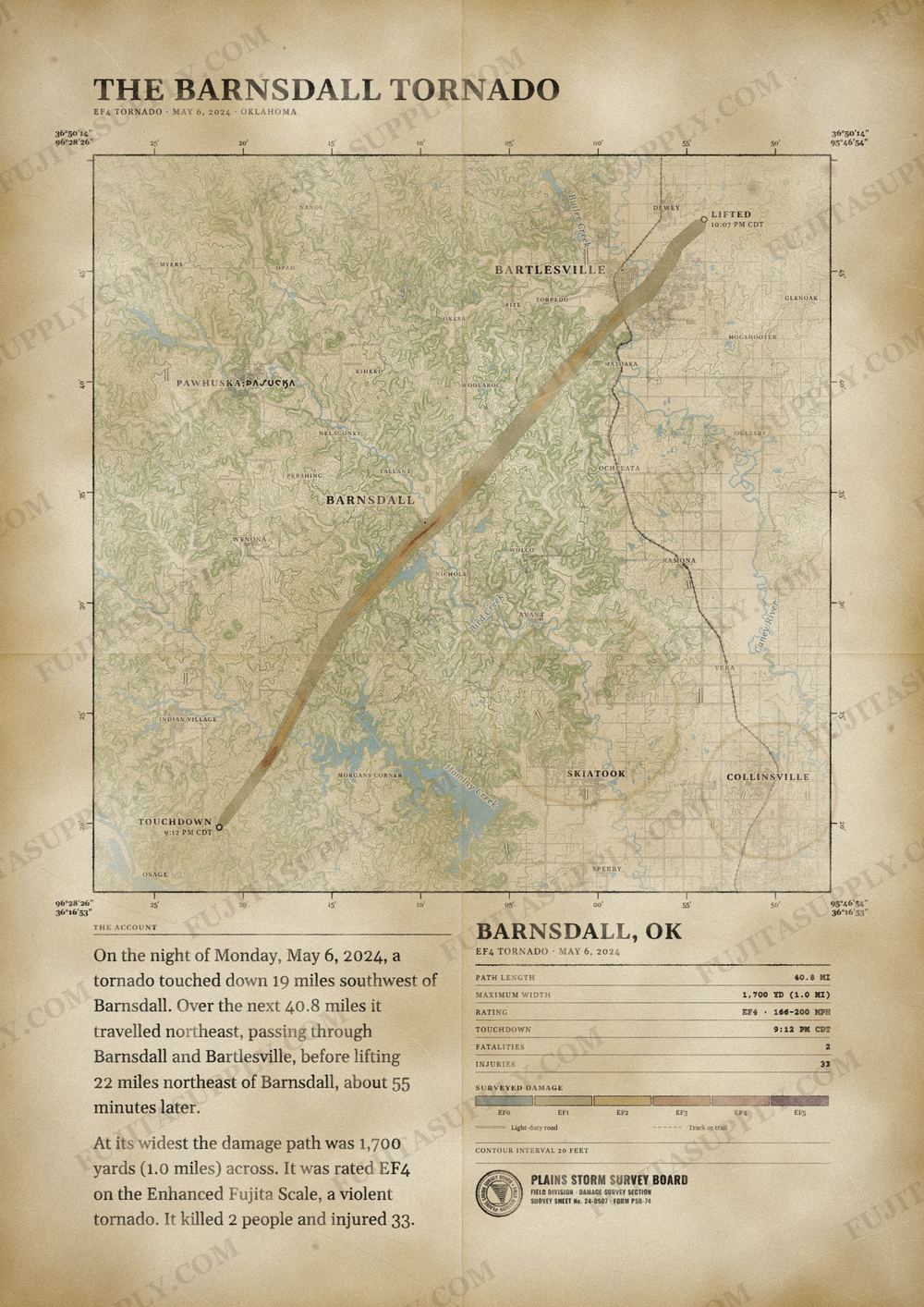
Barnsdall Tornado Map
In the evening hours of May 6, 2024, a large and destructive EF4 tornado moved through the communities of Barnsdall and Bartlesville in the state of Oklahoma, prompting a tornado emergency to be issued for both Barnsdall and Bartlesville, Oklahoma. The tornado was part of a larger outbreak of severe weather across the Great Plains. The tornado inflicted EF4 damage to eastern portions of Barnsdall before moving through central Bartlesville where it produced moderate damage. The tornado killed two people, injured thirty-three more, and inflicted an estimated total of $25 million (2024 USD) in damage along a 40.8-mile (65.7 km) path. The tornado was the third to be rated EF4 in 2024, and was part of the most active year for tornadoes in Oklahoma history.
The path of the Barnsdall tornado
On the night of Monday, May 6, 2024, a tornado touched down 19 miles southwest of Barnsdall. Over the next 40.8 miles it traveled northeast, passing through Barnsdall and Bartlesville, before lifting 22 miles northeast of Barnsdall, about 55 minutes later.
At its widest the damage path was 1,700 yards (1.0 miles) across. It was rated EF4 on the Enhanced Fujita Scale, a violent tornado. It killed 2 people and injured 33.
The track, widths and figures on this map come from National Weather Service damage surveys, so they can differ slightly from totals published elsewhere.
What was the Barnsdall tornado?
The Barnsdall tornado was a violent EF4 vortex that struck northeastern Oklahoma on the evening of May 6, 2024. The storm developed southeast of Hominy and moved northeast through Osage and Washington counties. It inflicted severe damage on the town of Barnsdall and the city of Bartlesville. The tornado was the second to hit Barnsdall in five weeks and occurred during an outbreak of severe weather across the central United States.
What was the Barnsdall tornado wind speed?
Meteorologists estimated the peak wind speed of the Barnsdall tornado at 180 mph. This maximum velocity occurred during the Osage County segment of the track, placing the storm in the EF4 category on the Enhanced Fujita scale. The winds weakened as the vortex crossed into Washington County, where officials recorded a maximum estimated speed of 125 mph. Assessors determined these figures based on the intense structural and tree damage found along the path.
What was the Barnsdall tornado path?
The Barnsdall tornado traveled a total distance of 40.8 miles across northeastern Oklahoma. The vortex touched down southeast of Hominy in Osage County at 8:12 p.m. CST and moved northeast through Barnsdall. It then crossed into Washington County near Gap Road and tracked through the southwestern, central, and northeastern sections of Bartlesville. A squall line ultimately merged with the supercell, ending the tornado near Dewey at 9:07 p.m. CST.
How many people died in the Barnsdall tornado?
Two people died in the Barnsdall tornado, and 33 others sustained injuries. Both fatalities occurred in Osage County when the storm struck the town of Barnsdall. A collapsed home killed a woman named Rhonda Hayman during the event. The storm also killed an 81-year-old man named Wayne Hogue, whose body authorities recovered from Bird Creek several miles south of town days later. No casualties occurred during the Washington County portion of the track.
What did the Barnsdall tornado destroy?
The Barnsdall tornado destroyed 65 homes and businesses in Osage County and damaged over 1,000 structures in Washington County. The vortex inflicted severe damage on a 160-acre wax manufacturing plant on the southeast side of Barnsdall. It snapped numerous metal power poles and completely debarked trees along Highway 20. In Bartlesville, the storm drove wooden boards into the Hampton Inn and tore the roof off the building.
What caused the Barnsdall tornado?
The Barnsdall tornado originated from a supercell thunderstorm that formed east of a sharpening dry line. Very strong atmospheric instability developed ahead of the storms during the afternoon and evening of May 6. An approaching upper-level disturbance strengthened the wind fields over the region, creating intense mid-to-late evening wind shear. These combined atmospheric conditions promoted the evolution of supercells and the development of violent tornadoes across eastern Oklahoma.
What happened after the Barnsdall tornado?
Emergency workers evacuated the Barnsdall Nursing Home after the tornado caused an uncontrollable gas leak. First responders rescued approximately 25 people from collapsed buildings throughout the damaged community. NuCera Solutions initially planned to rebuild its ruined wax refinery but later announced the permanent closure of the facility. The Oklahoma state government allocated $45 million in budget funds to assist Barnsdall and other communities affected by the severe weather outbreak.