A tornado's color depends on how it is lit and what it is carrying. The visible funnel is a cloud of water droplets. It looks white when the sun shines on it and dark when the sun is behind it. Dust and debris tint it the color of the ground it crosses, and rain can hide it completely. The same tornado can look white to one person and black to another at the same moment.
Why do some tornadoes look white?
A white tornado is lit from the front. The droplets in the funnel are large enough to scatter every color of sunlight about equally, so the funnel looks white, like a cumulus cloud in sunshine. You see it when the sun is behind you and the tornado has picked up little dirt.
Why do some tornadoes look black?
Three things make a tornado look dark, and they often come together.
- The sun is behind it. The droplets and dust block the light, and the funnel shows as a silhouette.
- It is full of soil and debris. Plowed fields, dark topsoil and wreckage fill the funnel and the debris cloud at its base.
- It is wrapped in rain. Heavy rain around the tornado turns it gray or black, or hides it.
Does where you stand change a tornado's color?
Yes, and for most people in a tornado's path it makes the tornado look dark. We checked about 15,600 tornadoes rated EF1 or higher in the Storm Prediction Center record from 1995 to 2024, using the time and place each one touched down.
- 83% of the daytime tornadoes touched down with the sun in the western half of the sky. Most tornadoes form in the afternoon and evening.
- 91% traveled with an eastward heading, and 76% headed northeast.
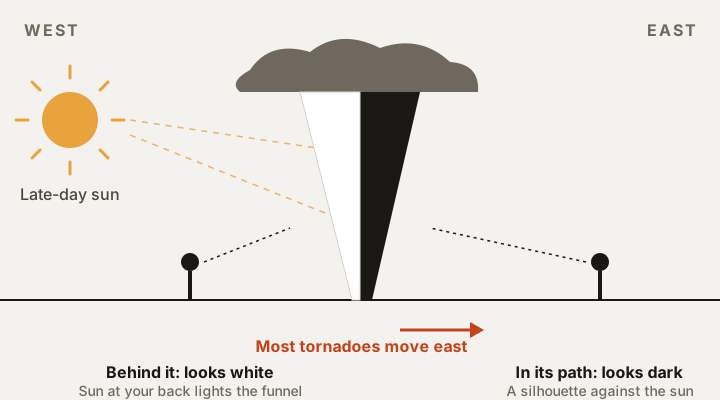
The same tornado, seen from behind and from its path in the late afternoon.
Put those together and the person in a tornado's path is usually east of it, looking west toward the sun. They see the dark, backlit side. The bright white tornadoes in storm chasers' photos are usually shot from behind or beside the storm, with the sun at the photographer's back. A dark tornado seen from your house is the same storm as the white one in those photos.
Why are some tornadoes brown or red?
A tornado takes on the color of the ground it crosses. Over the red clay soils of western Oklahoma and the Texas Panhandle it can turn reddish brown. Over the dark farm soils of Iowa and Illinois it can look almost black. On dry ground the dust it raises can give it a brown or orange tint.
Why do some tornadoes look orange or pink?
Low sunlight passes through more air before it reaches the funnel, and the blue light is scattered out on the way. What is left is yellow, orange and red, and a front-lit funnel shows those colors. In our data, 41% of the daytime tornadoes touched down with the sun less than 20 degrees above the horizon.
Why can't you see some tornadoes at all?
A tornado is only visible when water condenses in it or it lifts debris. In dry air there may be no funnel. The only sign is dust or debris spinning on the ground under the cloud base. The Storm Prediction Center lists that as a tornado warning sign in its own right.
Rain can hide a tornado too. Many are wrapped in heavy rain and cannot be seen from any direction.
Darkness hides the most. In our data, 34% of EF1 and stronger tornadoes touched down after dusk. In the Southeast the share was 44%, against 31% on the Plains. At night a tornado shows only in flashes of lightning, or as bright blue-green flashes near the ground where power lines are snapping. The Western Kentucky tornado touched down at 8:54 p.m. CST on December 10, 2021, and crossed downtown Mayfield at 9:28 p.m. in the dark.
Does a tornado's color tell you how strong it is?
No. Color comes from light, water and soil. A tornado's rating comes from the damage it leaves, which we explain in how a tornado is measured. Shape is just as poor a guide, as our guide to the types of tornadoes shows.
For tornado prints and gifts, see our gift guide for tornado lovers.