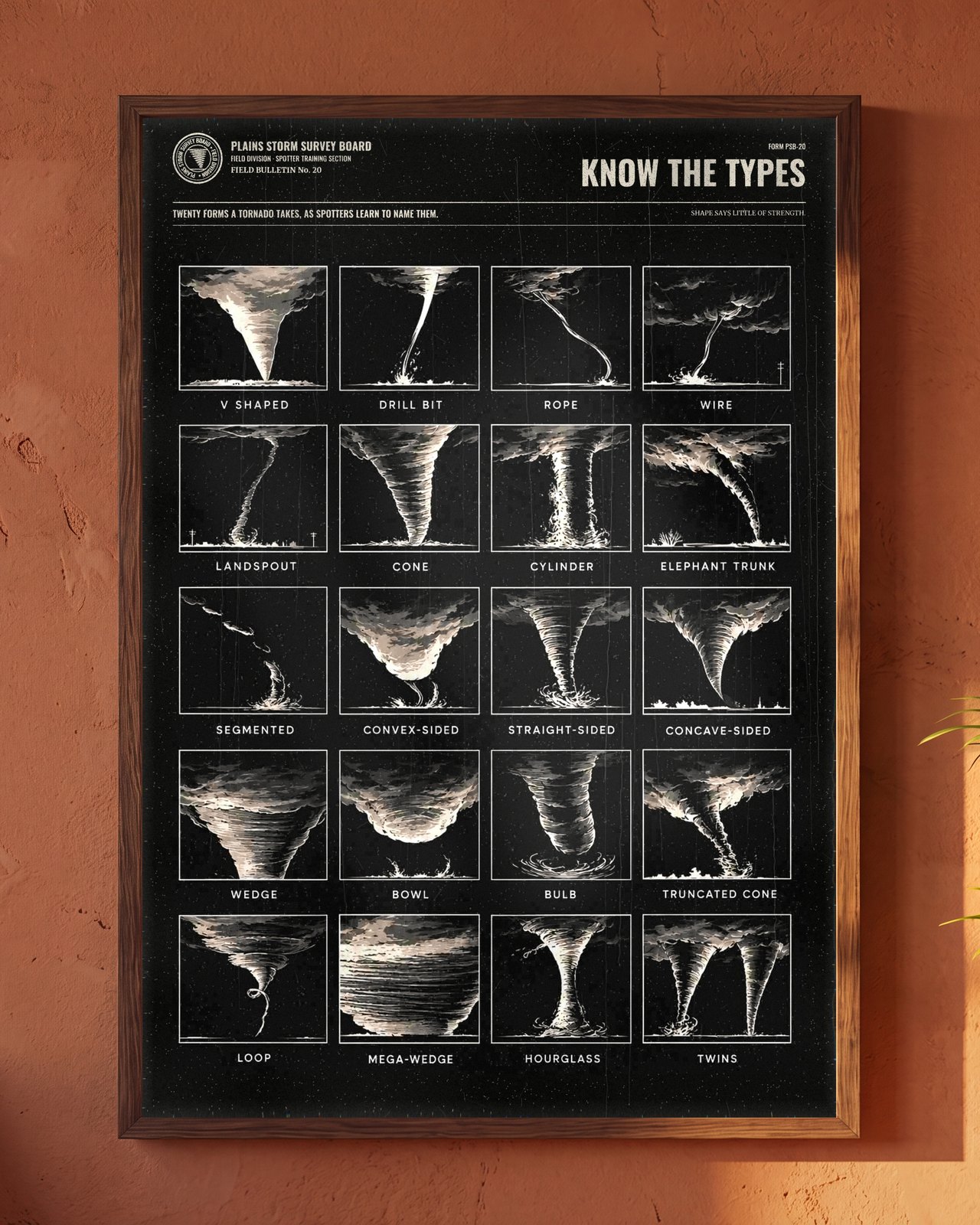
Tornadoes are named by the shape of their condensation funnel, the cloud you can see. Storm spotters and chasers use about 20 names, from the thin rope to the mile-wide wedge. Most of these names describe a look, and one tornado can pass through several of them in a few minutes. Only one name on the list, the landspout, marks a tornado that forms in a different way.
Shape says little about strength. The narrow Elie tornado in Manitoba was rated F5. The 2.6-mile-wide El Reno tornado in Oklahoma was rated EF3. Ratings come from the damage a tornado leaves, so you cannot judge one from its outline.
Thin tornadoes
What is a rope tornado?
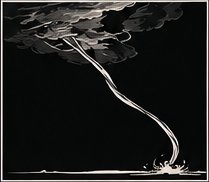
A rope tornado is a thin, twisting funnel that can stretch sideways across the sky. Most tornadoes start and end as ropes. The rope stage usually means the tornado is weakening as cooler air cuts off its supply of warm inflow. It can still do damage while it ropes out. We explain that stage in how tornadoes dissipate.
What is a wire tornado?
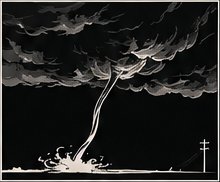
A wire tornado is thinner than a rope, often a single thread of cloud with a small debris cloud at the bottom. It is usually seen in the last moments of a tornado or with a landspout. The thread can be hard to see against a bright sky.
What is a drill bit tornado?
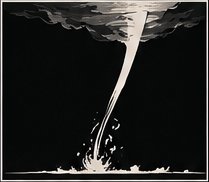
Drill bit is chaser slang for a narrow funnel that tapers to a point and shows tight spiral bands, like the threads of a bit. It is an informal name. The 2007 Elie tornado took on a drill bit and cone appearance for much of its life and was still rated F5. Its story is in our Elie tornado article.
What is a loop tornado?
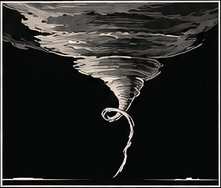
A loop tornado is a rope whose lower end curls into a loop or a kink. It happens late in a tornado's life, when winds at different heights pull the funnel in different directions. The loop usually means the tornado is about to break apart.
What is an elephant trunk tornado?
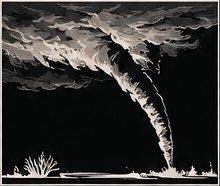
An elephant trunk tornado is a long funnel that bends out of the cloud base and curves down to the ground. It is close to a cone or a stovepipe in width. The bend comes from the storm moving away from the tornado's base, so the funnel trails behind it.
What is a segmented tornado?
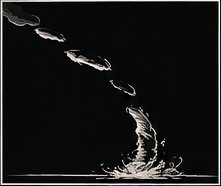
A segmented tornado shows its funnel in broken pieces with gaps between them. The air in the vortex is not condensing all the way down, but the circulation is continuous. If debris is spinning on the ground below the pieces, the tornado is on the ground. The famous "Dead Man Walking" photo of the 1997 Jarrell tornado caught a broken-up funnel of several small vortices.
Cone tornadoes
What is a cone tornado?
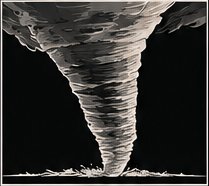
A cone tornado is wide where it meets the cloud and narrows to the ground, like an ice cream cone. It is the shape most people picture. Spotters split cones further by the line of their sides, which gives the next five names.
What is a V-shaped tornado?
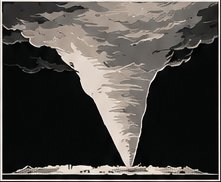
A V-shaped tornado is a cone with a very wide top that tapers sharply to a point at the ground. From a distance it looks like a letter V hanging from the storm.
What is a straight-sided tornado?
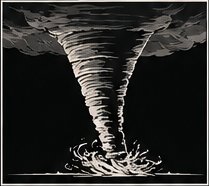
A straight-sided tornado is a cone whose sides run in straight lines from the cloud to the ground. It is the textbook cone.
What is a convex-sided tornado?
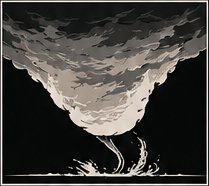
A convex-sided tornado has sides that bulge outward, giving the funnel a rounded, bowl-like look. These are often short and broad.
What is a concave-sided tornado?
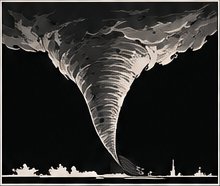
A concave-sided tornado has sides that curve inward, so the funnel flares out at the top and narrows to a long, thin tip. It looks like a horn.
What is a truncated cone tornado?
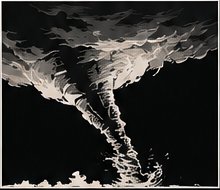
A truncated cone tornado looks like a cone with its tip cut off. It meets the ground with a wide, flat base, often hidden in a debris cloud.
What is a cylinder or stovepipe tornado?
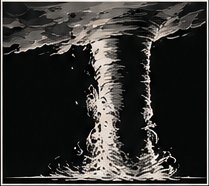
A cylinder tornado, usually called a stovepipe, is about the same width from the cloud base to the ground. It looks like a pipe hanging from the storm.
What is an hourglass tornado?
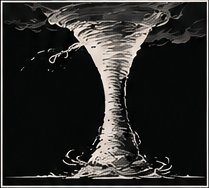
An hourglass tornado is wide at the top and at the bottom and pinched in the middle. The wide bottom is usually a debris cloud thrown up around the base of the funnel.
What is a bulb tornado?
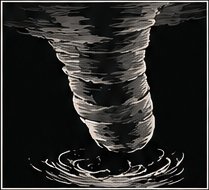
A bulb tornado has a swollen, rounded lower end, like a light bulb hanging from the cloud. The bulb often sits just above the ground with spinning debris underneath.
Wide tornadoes
What is a wedge tornado?
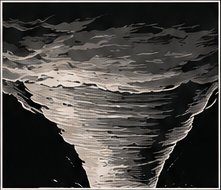
A wedge tornado is at least as wide at the ground as it is tall from the ground to the cloud base. The name is often used for any large tornado, but a true wedge is rare. The 2013 Moore tornado was about 1.1 miles wide at its widest.
What is a mega-wedge tornado?
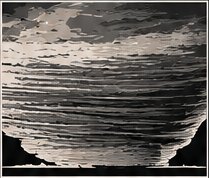
Mega-wedge is an informal name for the widest wedges, a mile or more across. They are often wrapped in rain, so from the ground they look like a dark wall of cloud. The 2004 Hallam tornado in Nebraska was 2.5 miles wide. The 2013 El Reno tornado reached 2.6 miles, the widest on record.
What is a bowl tornado?
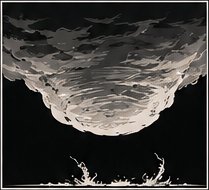
A bowl tornado is a broad, rounded lowering of cloud that has not condensed all the way to the ground. Debris spins on the ground underneath it. That debris means the tornado is already on the ground. A bowl often grows into a wedge.
Other types
What is a landspout?
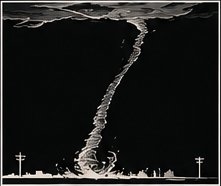
A landspout is a tornado that forms without a rotating thunderstorm above it. The National Weather Service defines it as a tornado with no wall cloud and no mesocyclone on radar. Its spin starts at the ground and is stretched upward by a growing cloud. Landspouts usually look like ropes and are usually weak. They are hard to detect on radar, so they can touch down without a warning.
What are twin tornadoes?
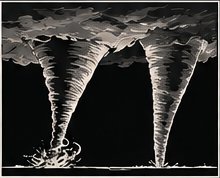
Twin tornadoes are two tornadoes on the ground at the same time from the same storm. On June 16, 2014, two tornadoes struck near Pilger, Nebraska, side by side. Both were rated EF4. Our Pilger archive page maps the path.
Does the shape of a tornado show how strong it is?
No. Tornadoes are rated on the Enhanced Fujita scale from the damage they cause. A narrow tornado can be violent, and a wide one can be weaker than it looks.
- Elie, Manitoba, June 22, 2007. A narrow drill bit and cone tornado, rated F5. It is the only F5 in Canadian records.
- El Reno, Oklahoma, May 31, 2013. The widest tornado on record at 2.6 miles, rated EF3. It hit open country, so there was little to show the strength of its winds.
The visible funnel is only the part of the vortex where water condenses. The damaging winds can reach well beyond it. How the EF rating is set is in how a tornado is measured.
Why do tornadoes look so different?
Moisture is the main reason. In humid air the cloud base is low, so the funnel condenses closer to the ground and looks wider and darker. In dry air on the High Plains, the cloud base is high and the same tornado can look like a thin rope or show no funnel at all.
Rain, dust and light change the look too. A tornado wrapped in rain may be invisible. One crossing plowed fields turns brown from dust. A tornado lit from behind by the setting sun shows as a dark shape, and one lit from the front shows white. This is why spotters watch for spinning debris on the ground as well as a funnel.
The Tornado Types Chart is one of the prints in our gift guide for tornado lovers.